
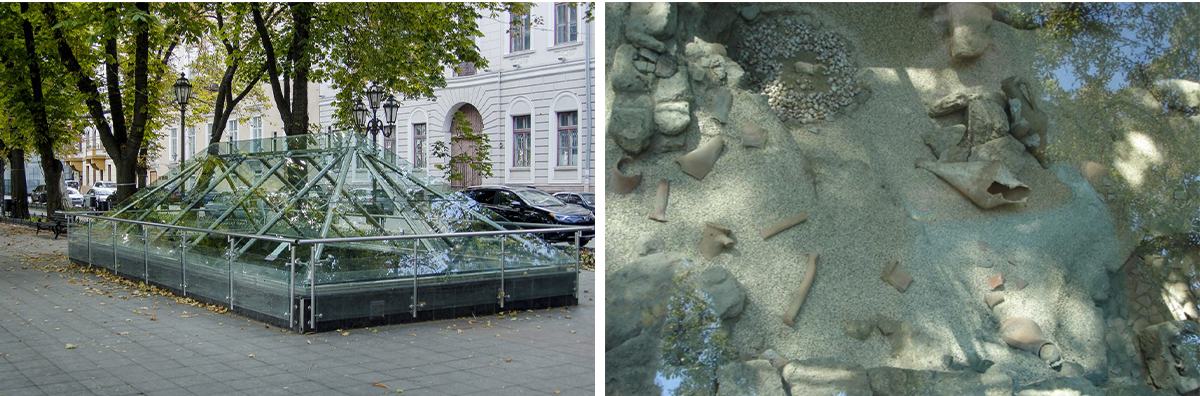
 The ancient predecessor of Odessa is the ancient Greek city of Havan Istrion, which was located in the territory of modern central Odessa over two and a half thousand years ago. The remnants of this ancient city are preserved beneath the entire Primorsky Boulevard at a depth of 1.5 meters. Adjacent to the present-day Opera Theater, there was a necropolis (translated from Ancient Greek as “city of the dead,” a cemetery). High burial mounds were situated in Greek Square until they were demolished during the construction of Odessa’s market buildings in 1803. Two burials were also found in 1910 at the corner of Ievropeiska (formerly Kateryninska) and Hretska Street, numerous fragments of ancient vases and amphorae were found in Pale Royal. The largest number of ancient burials were found in the area of Theatre Lane. In March 1823, one of the workers was digging a trench in the courtyard of the Telesnytsky House (Primorsky Boulevard, near the “Londonska” Hotel). Suddenly, he found a burial with human skeletal remains and luxurious Greek vases. In the courtyard of the Delavoz House (Theatre Lane on the corner of Primorsky Boulevard), an “ancient tomb, like others, was lined with simple limestone.” And in the garden of Mr. Saint-Pre’s house, a burial with a red-figure painted vase was found. This indicates that the residential quarters of the ancient city on Primorsky Boulevard in the 5th century BC consisted of stone buildings with tiled roofs, and inside were heating stoves. Where the Marine Station stands today, there was also a port in ancient times. But the oldest district of Havan Istrion was discovered in 1996 by Professor A.O. Dobrolyubsky’s expedition during excavations near the Vorontsov Palace. The first Greek colonists built temporary huts here, dug pits for grain storage, and arranged cult sites in the middle of the 6th century BC, centuries before the stone buildings opposite the “Londonsky” Hotel..
 One of the main activities of the first settlers was fishing. For instance, around one of the huts, a pit was found containing a bundle wrapped in a bay net, of which only hundreds of stone and ceramic fishing weights remained. Nearby were special fish plates with bone remnants, a salt shaker, several large vessels, an iron knife, and a sharpening stone. According to scientists, this was a neglected pit of an unknown fisherman.
Havan Istrion is the oldest and largest of the ancient settlements in the territory of Odessa. The ancient Greeks founded 12 settlements around the Odessa Bay. The most significant among them were: the settlement of Sukhyi Liman, opposite the present-day city of Chornomorsk, the settlement of Zhevakhova Hora, on the elevation between the Khadzhibey and Kuialnytsky estuaries, and the settlement of Luzanivka, on the territory of the modern children’s camp “Moloda Hvardiia”.
The settlements of Luzanivka and Havan Istrion were located on opposite sides of the bay and were rivals, as in the 4th century BC, the border between the territories of the two largest Greek states of that time – Istria and Olbia – ran along the Khadzhibey Estuary. Odessa archaeologists made a unique find on Zhevakhova Hora. In one of the ancient semi-buried huts, a letter on a lead plate was found, dating back to the 24th century. It was addressed to a certain aristocrat from Olbia named Protagor, offering him to return home due to some events that had turned unfavorable for him. Therefore, Protagor presumably set off immediately, leaving behind in the far corner of his modest dwelling an important message – fortunately, Olbia was just a day’s journey from here. This letter awaited archaeologists for two and a half thousand years.
On Zhevakhova Hora in the 5th to 4th centuries BC, there was a grand sanctuary dedicated to the ancient Greek goddess Demeter, the patroness of fertility and agriculture. In special cult pits, archaeologists discovered “gifts” from the ancient Greek inhabitants of the shores of the Odessa Bay to their divine patroness: amphorae, fish plates, refined black-figure pottery, rings, bronze arrowheads, fishing weights, iron knives, and even perfume vessels. In honor of Demeter, a special festival called Thesmophoria existed in the Black Sea region. Only women participated in this festival. Thesmophoria were associated not only with agriculture and fertility but also with the marital lives of women. The sanctuary at Zhevakhova Hora was located on international maritime trade routes. Therefore, it is possible that the Olbian aristocrat Protagor was not only hiding here from his urban problems but also participating in cult rituals, “appeasing the gods” during difficult times for himself.
On Zhevakhova Hora in the 5th to 4th centuries BC, there was a grand sanctuary dedicated to the ancient Greek goddess Demeter, the patroness of fertility and agriculture. In special cult pits, archaeologists discovered “gifts” from the ancient Greek inhabitants of the shores of the Odessa Bay to their divine patroness: amphorae, fish plates, refined black-figure pottery, rings, bronze arrowheads, fishing weights, iron knives, and even perfume vessels. In honor of Demeter, a special festival called Thesmophoria existed in the Black Sea region. Only women participated in this festival. Thesmophoria were associated not only with agriculture and fertility but also with the marital lives of women. The sanctuary at Zhevakhova Hora was located on international maritime trade routes. Therefore, it is possible that the Olbian aristocrat Protagor was not only hiding here from his urban problems but also participating in cult rituals, “appeasing the gods” during difficult times for himself.
In the second half of the 4th to the beginning of the 3rd century BC, Olbia enters into conflict with neighboring Greek states: Chersonesus (Crimea, at the site of modern-day Sevastopol) and Istria (near the mouth of the Danube). The reason for the conflict is simple. From this time onwards, Greek sailors learned to navigate the seas without following the coastline (known as cabotage sailing – along the coast). Now, upon entering the Black Sea, ships would anchor in Istria and then head directly to Chersonesus across open seas, halving their journey and bypassing Olbia, which suffered losses as a result. By waging war with Istria, Olbia aimed to redistribute spheres of influence in the region to undermine the prestige of its powerful neighbors. Havan Istrion served as a border outpost of the Istrian state, located on the borders with the Olbian polis (to which Luzanivka was subordinate). As a result of military clashes, the ancient predecessor of Odessa fell into decline even before the beginning of the 3rd century BC, while Luzanivka settlement continued to exist for another century, until the 2nd century BC.
The cessation of life in ancient settlements and cities in the territory of the Northwestern Black Sea region is linked to the invasion of the wild nomadic tribes of the Huns in the year 375. For many centuries, the lands around the Odessa Bay turned into uninhabited “Wild Steppes”.
(Click on the banner to read more)

_______________________________
The text was translated from Ukrainian by Artificial Intelligence