Previous section (click the link to return):
←4.1.Odessa (Odesa). Period 1794-1822♦
←4.2.Odessa (Odesa). Period 1823-1899↓
←4.3.Odessa (Odesa). Period 1900-1914↓
←4.4.Odessa (Odesa). Period 1914-1917↓
←3.1.Northern Black Sea Region XV-XVIII centuries♦
←3.2.Hocabey-Khodzhabey (Khadzhibey). Period of XV-XVIII centuries↓
←3.3.Khadzhibey-Odessa. Period XVIII century. Northern Black Sea Region XVIII century↓
←2.1.Kotsubey (Kochubiyiv). Period XV century. Eastern Europe II-XV centuries♦
←1.1.Ancient cities in the place of modern Odesa♦
LIBERATION STRUGGLES or THE UKRAINIAN REVOLUTION OF 1917-1921
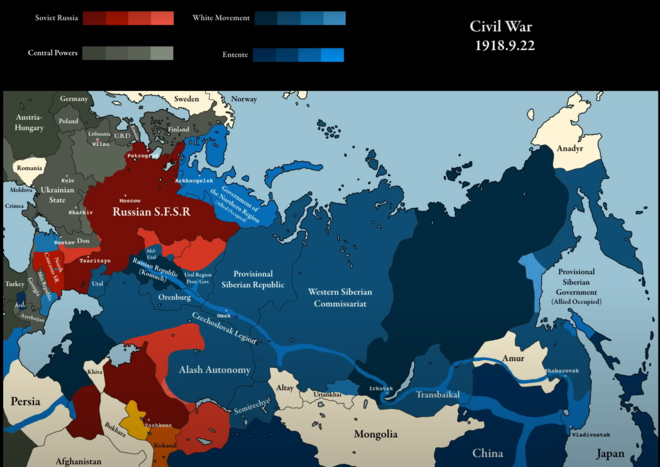
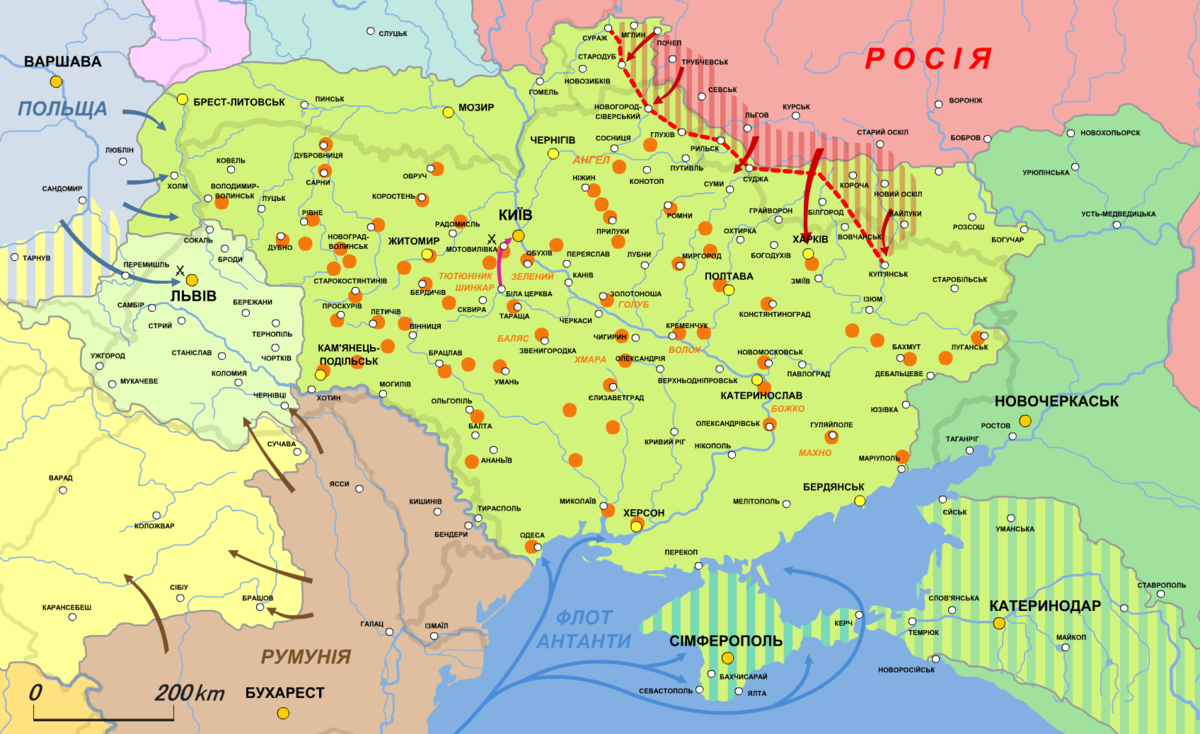
During the period of 1917–1921, Ukraine experienced various forms of national statehood: the Ukrainian People’s Republic (UPR), the Ukrainian State, the West Ukrainian People’s Republic (ZUNR), the Kuban People’s Republic, and the Crimean People’s Republic (DPR). Ukrainian ethnic territories were divided among the Ukrainian Soviet Socialist Republic (UkrSSR), the Polish Republic, the Kingdom of Romania, and the Czechoslovak Republic. Thus, the Ukrainian national-democratic revolution suffered a defeat. This defeat was a result of the fragmentation of the political elite, the unfinished process of nation-building, the discrepancies between national and social objectives of the liberation movement, and its dependence on external political and primarily military factors. However, despite not achieving its goal, the Ukrainian Revolution initiated the process of forming a modern political nation and revived the tradition of Ukrainian statehood.
State formations on the territory of Ukraine in 1917–1921:
National-state formations
- Ukrainian People’s Republic
- Ukrainian State
- West Ukrainian People’s Republic
- Crimean People’s Republic
- Kuban People’s Republic
Quasi-state formations:
- Kholodny Yar Republic
- Makhnovshchina
- Bashtan Republic
- Vysunsk People’s Republic
- Medvin Republic
- Mliyevka Republic
- Black Forest Republic
- Yampil Republic
Soviet republics:
- Ukrainian People’s Republic of Soviets
- Donetsk–Kryvyi Rih Soviet Republic
- Odessa Soviet Republic
- Taurida Soviet Socialist Republic
- Ukrainian People’s Republic of Soviets
- Kuban Soviet Republic
- Kuban-Black Sea Soviet Republic
- Ukrainian Soviet Socialist Republic
- Galician Soviet Socialist Republic
- Bessarabian Soviet Socialist Republic
February Revolution. Ukrainian Central Rada
 On February 23 (March 8), 1917, in Petrograd, the capital of the Russian Empire, mass strikes began. In the following days, the State Duma took an oppositional stance against the government, and parts of the capital’s garrison joined the strikers. On February 27 (March 12), all power was concentrated in the hands of the Provisional Committee of the State Duma. On March 2 (15), the members of this committee accepted the act of abdication from the monarch and formed the Provisional Government. Simultaneously with the Provisional Government, the Petrograd Soviet of Workers’ and Soldiers’ Deputies was established in Petrograd, which later influenced the formation and activities of the government
In early March, Ukrainians in Petrograd created the Temporary Ukrainian Revolutionary Committee, which on March 2 (15) addressed the Ukrainians of the capital, urging them to direct their energy “towards the acquisition of their own national-political rights” and to fill it “with the consciousness of their own national interests.” Ten days later, the Committee organized a large demonstration in the center of Petrograd.
Between March 3—5 (16—18), the organs of the Tsarist administration in Ukraine were practically abolished, and executive power passed to the governors and county commissioners appointed by the Provisional Government. Just as in Russia, Councils of United Organizations and Councils of Workers’ and Soldiers’ Deputies began to form in Ukraine.
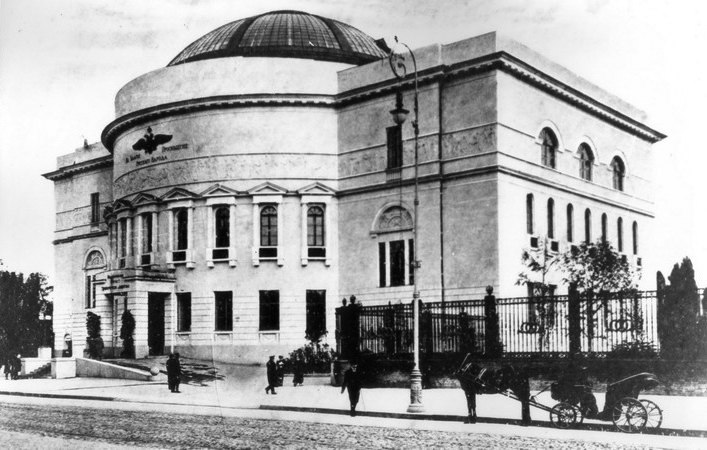
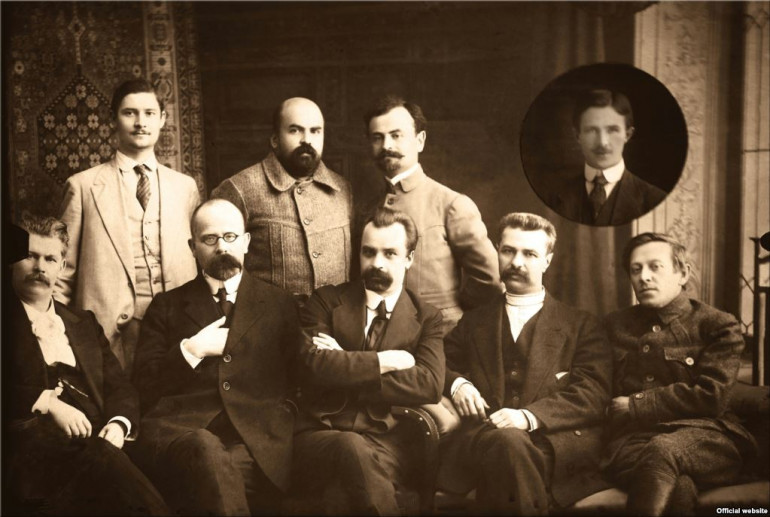 In early March, around 100 representatives of Ukrainian organizations gathered at the “Rodyna” club of the Society of Ukrainian Progressives (TUP). During this meeting, the idea of creating a special organization to coordinate the national movement was born. However, the principles of its formation sparked a sharp debate. Members of TUP (Serhiy Yefremov, Dmytro Doroshenko, Lyudmyla Starytska-Chernyakhivska, and others) believed that their organization should become the center for uniting national forces. This approach, however, did not gain the support of most participants. At the initiative of social democrat Dmytro Antonovych and other participants, it was decided that the new body should be formed on a coalition basis. On March 7, elections were held for the leadership core of the Central Rada. The well-known historian and public figure Mykhailo Hrushevsky was elected head of the Central Rada, though at that time he had not yet returned to Kyiv from Moscow, where he was serving his exile
In the early weeks of March, the Central Rada was one of the left-wing players in the socio-political life of the country, yielding initiative to Russian political parties and organizations. The situation changed when the Central Rada initiated a 100,000-strong demonstration in Kyiv, which culminated in a rally that supported a resolution for Ukraine’s autonomy. On April 6–8 (19–21), the All-Ukrainian National Congress was held in Kyiv, attended by about 900 deputies from various Ukrainian political, public, cultural, educational, and professional organizations. At the congress, deputies discussed various aspects of national-territorial autonomy for Ukraine, made decisions about creating regional authorities, and drafting an autonomous statute for Ukraine. They also elected 118 members to the Ukrainian Central Rada, including M. Hrushevsky as the head of the Rada, with V. Vynnychenko and S. Yefremov as deputy heads. Mandates as members of the Rada were granted to well-known Ukrainian public and political figures such as D. Doroshenko, M. Mikhnovsky, V. Prokopovych, Ye. Chykalenko, O. Shulhyn, A. Nikovsky, S. Rusova, V. Leontovych, L. Starytska-Chernyakhivska, and others
The resolutions of the National Congress received widespread attention. The demand for national-territorial autonomy for Ukraine was also included in the resolutions of the First All-Ukrainian Military Congress (May 5–8 (18–21)), attended by over 700 delegates representing 993,000 Ukrainian servicemen in the army and the rear. The Military Congress also expressed support for reorganizing the army on a national-territorial basis and forming a Ukrainian national army. To oversee the process of forming the armed forces, the Ukrainian General Military Committee was established under the Central Rada
On May 16 (29), a delegation from the Central Rada, led by V. Vynnychenko and S. Yefremov, arrived in Petrograd. Failing to reach an agreement with the Provisional Government and the Petrograd Soviet of Workers’ and Soldiers’ Deputies regarding Ukraine’s autonomy, the delegation returned to Kyiv at the end of May.
The unsuccessful negotiations in Petrograd and the prohibition of the Second All-Ukrainian Military Congress pushed the Central Rada towards more decisive actions. On June 3, during the Fourth General Assembly of the Central Rada, it was decided to address the Ukrainian people, calling on them “to organize and immediately lay the foundation for an autonomous order in Ukraine.” On June 10 (23), the Central Rada Committee adopted a document, which was made public on the same day at the All-Ukrainian Military Congress, declaring national-territorial autonomy for Ukraine. On June 15 (28), the Central Rada Committee established the General Secretariat as the Rada’s executive body, with Volodymyr Vynnychenko elected as the first General Secretary
On June 29 (July 12), a delegation from the Provisional Government arrived in Kyiv, consisting of Alexander Kerensky, Irakli Tsereteli, and M. Tereshchenko, to establish relations with the Central Rada. The delegation stated that the government would not oppose Ukraine’s autonomy but asked that the declaration of this principle be postponed, leaving the final approval of autonomy to the All-Russian Constituent Assembly.
On July 2 (15), a telegram arrived from Petrograd with the text of a government declaration recognizing the General Secretariat as the highest executive body in Ukraine and indicating that the government would favorably consider the development of a national-political statute for Ukraine by the Ukrainian Rada.
In response, on July 3 (16), the Central Rada proclaimed the Second Universal, which accepted the government’s call for unity, expanded the Rada with representatives of national minorities, and transformed it into the unified highest body of revolutionary democracy in Ukraine.
In mid-July, a Ukrainian delegation arrived in Petrograd to have the composition of the General Secretariat approved by the Provisional Government. The delegation brought with it the Statute of the Highest Administration of Ukraine (in its final version, the Statute of the General Secretariat), which stated in the preamble that the Central Rada was the body of revolutionary democracy for all peoples of Ukraine, with the goal of fully implementing Ukraine’s autonomy and preparing for the All-Ukrainian and All-Russian Constituent Assemblies. The government commission rejected the Statute of the General Secretariat and on August 4 (17) replaced it with a “Temporary Instruction,” which transformed the General Secretariat into a local body of the Provisional Government. Its powers were limited to 5 out of 9 Ukrainian provinces, and it lost the secretariats of military, food, judicial affairs, communications, postal services, and telegraphs. The pressure from the Provisional Government on the Ukrainian delegation did not stop with the approval of the government “Instruction.” On July 26 (August 8), in Kyiv, Don Cossacks and the cuirassier regiment staged an armed provocation against the Bohdan Khmelnytsky regiment, resulting in 16 Bohdanivtsi being killed and 30 wounded.
Ukrainian People’s Republic
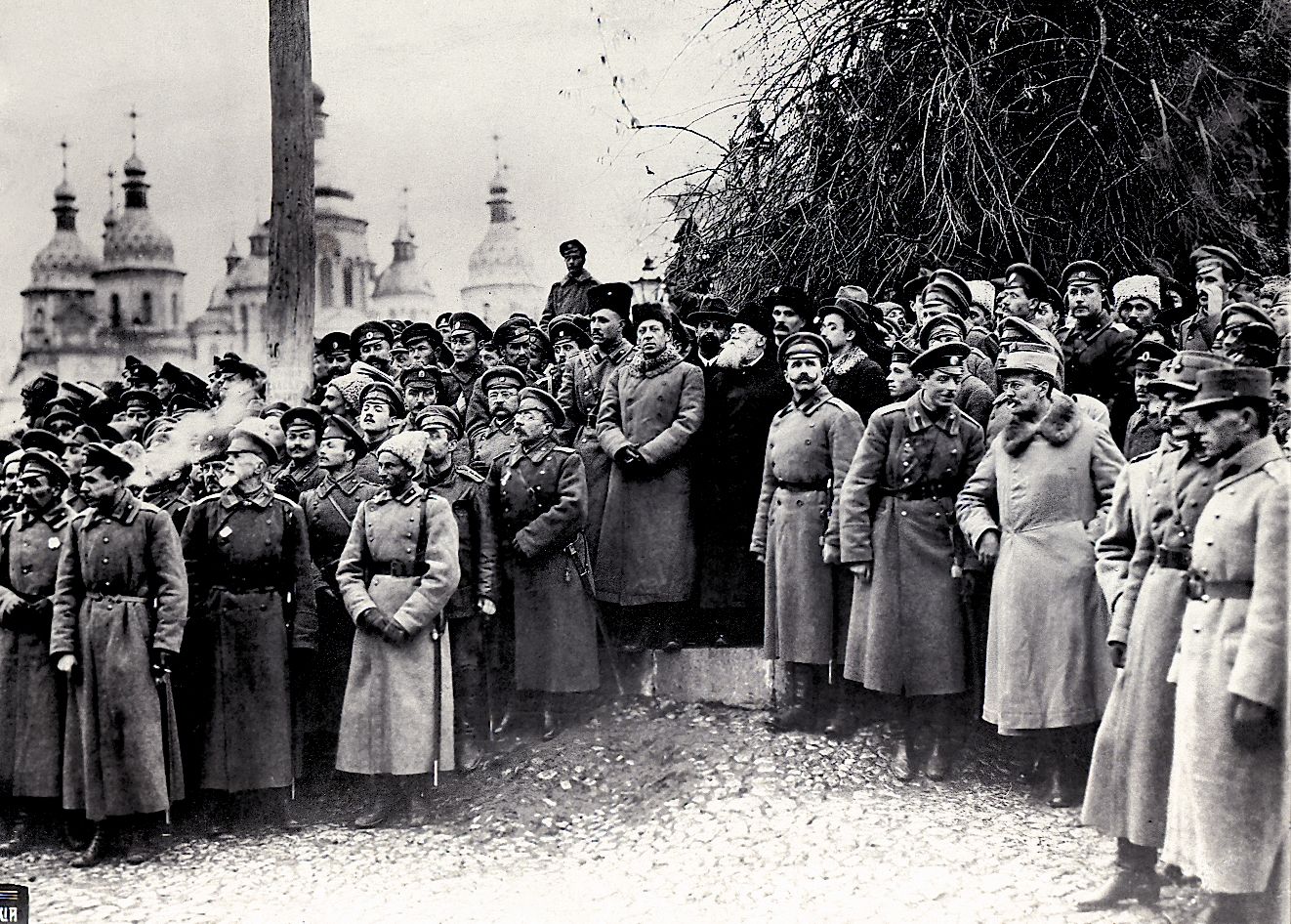
 On October 20th (November 2nd), 1917, the Third All-Ukrainian Military Congress began its work in Kyiv. At the congress, one of the leaders of the Ukrainian Socialist Revolutionaries criticized the compromise policies of the Central Rada and called for the establishment of a “Ukrainian Democratic Republic” through their own efforts. V. Vynnychenko declared that the General Secretaries were not officials of the Provisional Government and that the General Secretariat was accountable not to the Provisional Government but only to the Ukrainian democracy that had brought it into existence.
On October 25th (November 7th), news reached Kyiv of an uprising in Petrograd organized by members of the Russian Social Democratic Labour Party (Bolsheviks). The RSDLP(B) had formed in the spring of 1917, based on the extreme left-wing faction of the RSDLP. The party’s leadership had been accused of ties with the German government during the summer of 1917. The call from Kyiv Bolsheviks at a joint meeting of the executive committees of the councils of workers’ and soldiers’ deputies to raise an uprising and seize power was unsuccessful. On October 26th (November 8th), at a meeting of the Small Rada with representatives of various political and social organizations, the Regional Committee in Protection of Revolution in Ukraine was created, responsible to the Central Rada. All government bodies and all forces of revolutionary democracy in Ukraine were to be subordinate to this committee.
The command of the Kyiv Military District (KVO) condemned the creation of the Regional Committee for the Protection of the Revolution. On October 27th (November 9th), the Central Rada adopted a resolution on the authority in the country, emphasizing the need to transfer power “into the hands of the entire revolutionary democracy,” but not to the Soviets of workers’ and soldiers’ deputies, and also condemned the uprising in Petrograd. On the same day, the Bolsheviks announced their withdrawal from the Small Rada and at a meeting of the Soviets of workers’ and soldiers’ deputies formed a military-revolutionary committee. From October 29th to 31st (November 11th to 13th), an armed confrontation occurred in Kyiv in the Pechersk district between the Bolsheviks and the KVO units, ending in the Bolsheviks’ surrender.
On October 28th (November 10th), the Central Rada granted the General Secretariat the functions of the dissolved Regional Committee for the Protection of the Revolution. On October 29th (November 11th), the General Secretariat took control of military, food supply, and transportation matters. On October 31st (November 13th), a general assembly of the Central Rada extended the authority of the General Secretariat to the Kherson, Katerynoslav, Kharkiv, Kholm, and partially to the Tavria, Kursk, and Voronezh provinces. On November 1st, the General Secretariat appointed Lieutenant Colonel Viktor Pavlenko as the commander of the KVO troops.
Under these circumstances, on November 7th (20th), the Central Rada adopted the Third Universal, which declared the creation of the Ukrainian People’s Republic in federal association with the Russian Republic. The Universal also addressed land nationalization, the introduction of an 8-hour workday, the establishment of state control over production, the expansion of local self-government, the guarantee of freedom of speech, press, religion, assembly, unions, strikes, the inviolability of the person and home, and the abolition of the death penalty.
In November-December 1917, elections to the All-Russian Constituent Assembly took place, revealing that around 40% of voters supported the Socialist Revolutionaries, while the Bolsheviks received up to 25%. In Ukraine, Ukrainian socialist parties garnered two-thirds of the votes, with the Bolsheviks securing more than 10%. However, the Bolsheviks continued to hold power in Central Russia. Having seized power in Petrograd, V. Lenin was convinced that maintaining control over the army was far more crucial than the results of the elections to the Constituent Assembly. Although by mid-November, only 3 out of 15 Russian armies had expressed support for the Bolsheviks.
On November 9th (22nd), the Council of People’s Commissars (Sovnarkom) issued an order replacing the Supreme Commander-in-Chief, General M. Dukhonin, who had refused to obey the Bolsheviks, with Ensign M. Krylenko. Simultaneously, via radio and telegraph, the Sovnarkom addressed the army, informing them that regimental and divisional committees were granted the right to negotiate with the enemy for an armistice on their respective defensive sectors. The practice of “fraternization” with the enemy quickly spread along the front line. Thus, the overthrow of the Provisional Government by the Bolsheviks and the exit from the world war through “fraternization” with the enemy undermined law and order as well as social foundations. Moreover, after the Bolsheviks dispersed the Constituent Assembly, society lost the ability to influence the government through peaceful democratic means, raising the question of the Bolsheviks’ legitimacy.
УThe government of the Ukrainian People’s Republic condemned the Bolsheviks’ policies. In a statement by the General Secretariat on November 30th, the Bolsheviks were labeled as “irresponsible people who understand the revolution as the destruction of all organized life.” To stabilize the situation in the country and prevent anarchy in the army, the Central Rada and the General Secretariat called on regional governments to form a homogeneous socialist government. On November 17th, it was decided to take the initiative in forming such a government, and on November 23rd, the Southwestern and Romanian fronts were merged into one—the Ukrainian front.
On November 27th (December 10th), the Bolsheviks in Mogilev, at the General Headquarters, created a revolutionary field headquarters to fight against the “counterrevolutionary” forces of Kaledin, Dutov, and the Central Rada. In response to the Bolsheviks’ actions, the General Secretariat ordered the scattered Ukrainianized units stationed outside Ukraine to relocate to the territory of the Ukrainian People’s Republic, and on November 30th (December 13th), disarmed and expelled pro-Bolshevik elements from the Kyiv city garrison.
On December 4th (17th), the Council of People’s Commissars (Sovnarkom) issued a “Manifesto to the Ukrainian People with Ultimatum Demands to the Ukrainian Rada“. The Bolsheviks’ demands were that the Ukrainian Central Rada (UCR) must cease disorganizing the unified front and allowing military units to pass to the Don, Ural, and other regions, stop disarming Soviet and Red Guard units, and assist in combating the “counterrevolutionary Cadet-Kaledin uprising.” On December 4th (17th), the All-Ukrainian Congress of Soviets opened in Kyiv, with more than 2,000 delegates participating. The Congress expressed support for the Central Rada. The Bolsheviks, finding themselves in a significant minority, left the Congress the next day. On December 5th (18th), the Central Rada rejected the Bolsheviks’ “ultimatum demands”.
On December 9th (22nd), trains carrying Bolshevik troops arrived in Kharkiv. On the night of December 10th (23rd), Bolshevik forces disarmed the Ukrainianized units. At the same time, a group of delegates who had left the All-Ukrainian Congress of Soviets also arrived in Kharkiv. On December 11th-13th (24th-26th), the Bolsheviks staged an alternative All-Ukrainian Congress of Soviets. At this congress, 200 delegates represented only 89 Soviets and military-revolutionary committees, whereas there were over 300 Soviets in Ukraine at the time. This congress endorsed the uprising in Petrograd and the policies of Sovnarkom, declared the establishment of Soviet power in the Ukrainian People’s Republic (UNR), and elected the Central Executive Committee of Soviets of Ukraine, which in turn established the People’s Secretariat. On December 17th (30th), the Central Executive Committee of Soviets of Ukraine published a manifesto declaring the overthrow of the Central Rada and the General Secretariat, and the next day it created a regional committee to combat counterrevolution. Bolshevik forces began an offensive in the Donbas and southern Ukraine.
Meanwhile, the Central Rada and the General Secretariat took measures to halt the Bolshevik aggression. On December 15th (28th), a Special Defense Committee of Ukraine was established. On December 18th (31st), the General Secretariat appointed Colonel Yuriy Kapkan as commander of all Ukrainian forces to fight against the Bolsheviks, and on December 26th (January 8th), it adopted a resolution to create the UNR army. However, the UNR government encountered several issues while forming combat-ready units. While in late November to early December 1917, it could count on around 400,000 soldiers, by the end of December and January, the disintegration of the army led to a situation where, against the 12,000-strong Bolshevik force advancing on Kyiv, the UNR government could only muster about 15,000 soldiers stationed in various locations.
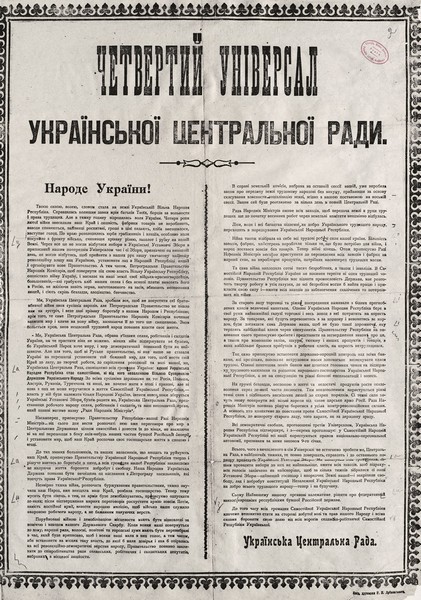 On January 11th (24th), 1918, the Little Council (Mala Rada) adopted the Fourth Universal, which declared the independence of the Ukrainian People’s Republic (UNR). The document stated: “Henceforth, the Ukrainian People’s Republic becomes an independent, free, sovereign state of the Ukrainian people.” The Fourth Universal also mentioned the formation of the Council of People’s Ministers, peace negotiations with the Central Powers, the disbanding of the regular army, and the formation of a “people’s militia,” along with a call to fight against the Bolsheviks.
On the night of January 16th (29th), an armed uprising began in Kyiv, involving certain parts of the city garrison and workers from the “Arsenal” factory, directed against the UCR. On January 22nd, the armed forces of the UNR suppressed this rebellion. Meanwhile, the Bolshevik offensive on Ukrainian territory continued. At the end of January, members of the Little Council and the Council of People’s Ministers were forced to relocate from Kyiv to Zhytomyr. On January 26th, Bolshevik forces captured Kyiv, leading to the onset of the “Red Terror,” which claimed the lives of several thousand people.
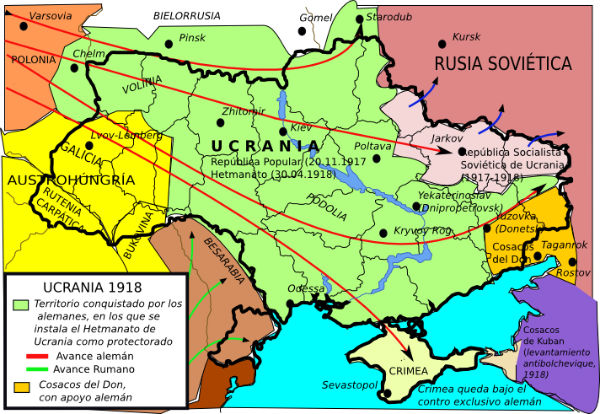
In February 1918, a peace treaty was signed in Brest-Litovsk between the UNR and the Central Powers. According to the terms, the Central Powers recognized the independence of the UNR and the Central Rada, the territories of Kholmshchyna and Beresteyshchyna were incorporated into Ukraine, and assistance was provided in the fight against the Bolsheviks in exchange for food supplies. In early March, the Central Rada returned to Kyiv, German and Austrian troops advanced to the eastern border of the UNR (the line Starodub – Rylsk – Belgorod – Valuyki – Kantemirovka – Rostov), the detachments of Petro Bolbochan liberated Crimea, and in April, Ukrainian flags were raised on ships of the Black Sea Fleet. On April 29th, 1918, at its final session, the Central Rada adopted the Constitution.
Ukrainian State
On the day the Constitution of the Ukrainian People’s Republic was adopted, conservative-monarchist forces proclaimed the Ukrainian State at the Agrarian Congress in Kyiv, establishing a military dictatorship under Hetman Pavlo Skoropadskyi, a former lieutenant general of the Tsarist army, who relied on military support from Germany. The Central Rada was dissolved, and the Council of Ministers was headed by Fedir Lyzohub. The Hetman managed to restore the functioning of the state apparatus, stabilize the financial and judicial systems, reinstate private land ownership, repeal the eight-hour workday, and restrict certain civil rights. Additionally, the Ukrainization of cultural life was initiated, and the Ukrainian Academy of Sciences was founded under the leadership of Volodymyr Vernadskyi, along with the establishment of the Katerynoslav University. In June 1918, a peace agreement was signed with the Bolsheviks, but recognition from the Allied Powers could not be secured. On November 11, 1918, World War I ended, Germany signed humiliating peace terms, and its troops withdrew from Ukraine. The Hetman was forced to seek external support from the White Movement and agreed to the formation of an All-Russian Federation of Nations.
Ukrainian People’s Republic. Directorate
The government of Skoropadskyi, lacking German support, was overthrown by an anti-Hetman uprising led by Symon Petliura. On December 14, 1918, the Ukrainian People’s Republic was restored, headed by the Directorate, a collective body of socialist opposition to the Hetman’s regime. The Directorate was led by the pro-Soviet Volodymyr Vynnychenko and the pro-Antanta Symon Petliura. Petliura succeeded in mobilizing a 100,000-strong army, which defeated Skoropadskyi’s forces in the Battle of Motovylivka. On December 18, the Directorate took control of Kyiv, and Skoropadskyi, after abdicating, fled to Germany. In February 1919, under pressure from the advancing Red Army forces, the Directorate abandoned Kyiv and retreated westward. Seeking an understanding with the Entente powers, the pro-Soviet Vynnychenko and several other socialists left the government.
Ukrainian Socialist Soviet Republic
 In Belgorod, in the fall of 1918, a government of the Ukrainian Socialist Soviet Republic (USSR) was established under the leadership of Georgiy Pyatakov. In March, the Third All-Ukrainian Congress of Soviets in Kharkiv adopted the Constitution of the USSR, declaring Ukraine a country of Soviets. All power was concentrated in the hands of the delegates of the congresses, which convened periodically, and in the period between them, authority was vested in the All-Ukrainian Central Executive Committee, chaired by Hryhoriy Petrovsky. Christian Rakovsky was appointed as the head of the government. At the beginning of June, all Soviet republics entered into a “military-political union,” and formal independence was abolished, with the implementation of the policy of “war communism” beginning. In 1918, the Bolsheviks founded their own party, the All-Union Communist Party (Bolsheviks), with the goal of building a “bright communist future.” In pursuit of a radical transformation of society, they sought to ignite the “flames of world revolution.” The instruments they chose to achieve their goals included the nationalization of all property, the abolition of private ownership, “Red Terror” against class enemies, a rationing system for distributing goods, the expropriation of grain from peasants—known as prodrazvyorstka, and mandatory universal labor duty.
Western Ukrainian People’s Republic. Act of Unification with the Ukrainian People’s Republic
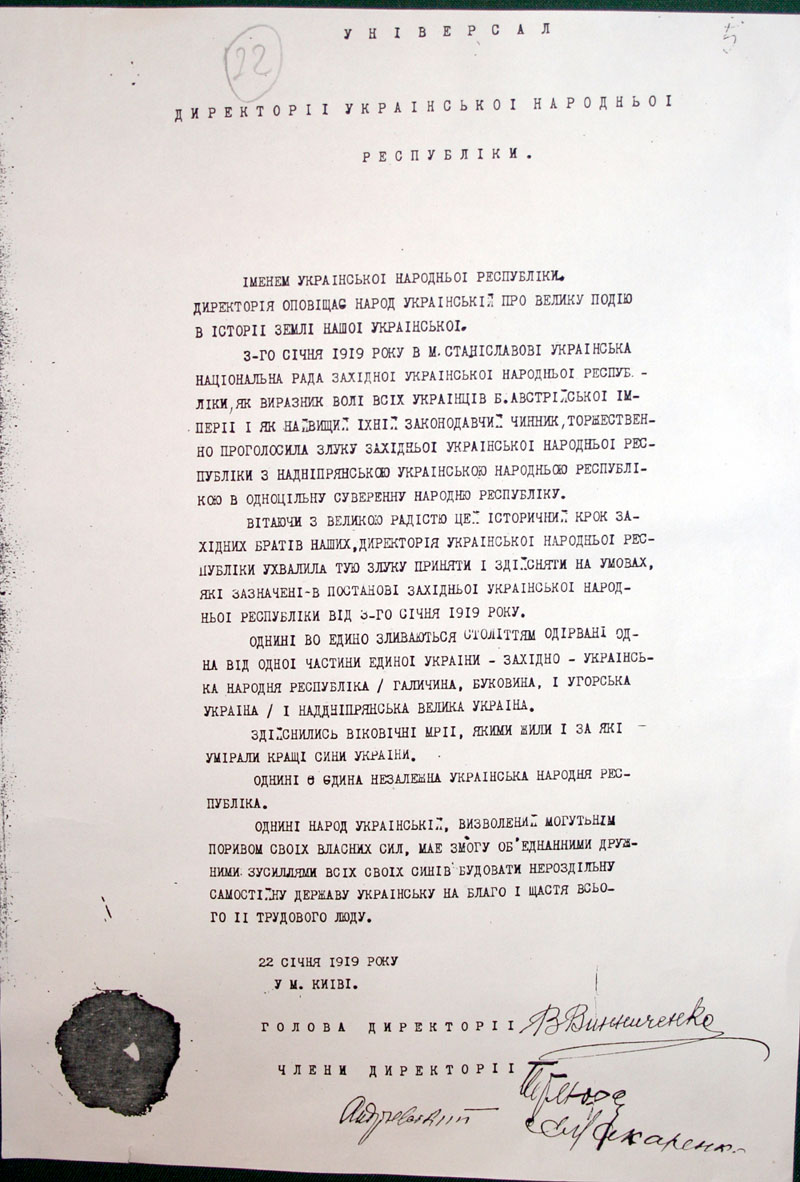 In the autumn of 1918, the Ukrainians of Galicia formed the Ukrainian National Council, and young officers established the Central Military Committee (Dmytro Vitovsky). On November 1, 1918, Ukrainian military forces took power in Lviv (known as the November Uprising), and on November 13, they proclaimed the Western Ukrainian People’s Republic. Yevhen Petrushevych became the President of the republic, and Kost Levytsky was appointed as the head of the government. The republic succeeded in organizing state affairs, implementing the Ukrainian language as the state language, establishing an 8-hour workday, transferring land to peasants without compensation, guaranteeing cultural autonomy to other peoples, and holding elections for governmental bodies. However, all these reforms had to be carried out under the conditions of the Polish-Ukrainian War. The Ukrainian Galician Army (UGA) was created based on veterans of the Legion of Sich Riflemen. On January 22, 1919, the Act of Unification of the two Ukrainian states, the Ukrainian People’s Republic (UNR) and the Western Ukrainian People’s Republic (ZUNR), was solemnly proclaimed in Kyiv’s St. Sophia Square. However, the Poles quickly recaptured Lviv, and in the spring of 1919, with the help of a 60,000-strong army of Poles, interned by France from the German army under the command of General Haller, launched an offensive. The UGA retreated beyond the Zbruch River, and by early June 1919, almost all of the ZUNR was occupied by Poland, Romania, and Czechoslovakia. In June, the UGA conducted a successful Chortkiv offensive, but they were unable to continue the advance. The UGA crossed the Zbruch to join forces with the UNR. Some troops ended up in Czechoslovakia, where they became known as the “Ukrainian Brigade.” On April 21, 1920, Poland and Ukraine agreed that the border should follow the Zbruch River. According to the decisions of the post-war Paris Peace Conference, the western Ukrainian lands were to be transferred to the newly formed Poland. The existence of socialist Ukraine, a former ally of the Central Powers, was possible only as a buffer with Bolshevik Russia. Holding out hope for the victory of the White Movement in Russia, the eastern border of Poland was officially approved by the Entente countries only in 1923. That same year, the exiled ZUNR government self-dissolved. According to the peace conferences, Bessarabia was transferred to Romania, and Transcarpathia to Czechoslovakia.
Ukrainian People’s Republic – Ukrainian Socialist Soviet Republic
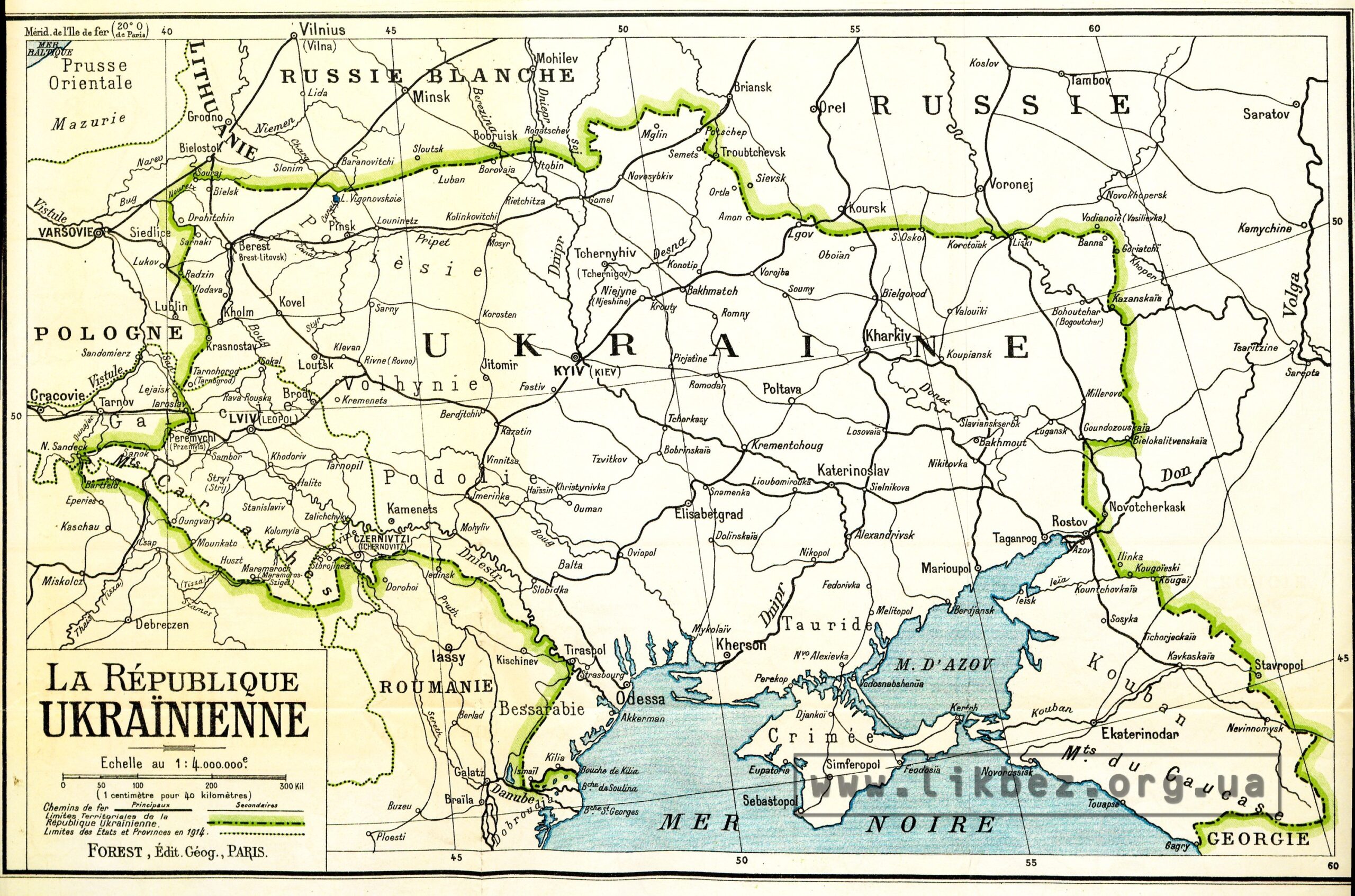 Widespread discontent with the war communism of the Ukrainian SSR led to peasant uprisings, the largest of which took place in Yelysavethrad in May 1919, led by Ataman Nykyfor Hryhoriev. The Volunteer Army of the White Movement, under the command of General Anton Denikin, with the support of the Entente forces, pushed the Bolsheviks out of the south, reinstating the old Tsarist order. As a result of the offensive by the Armed Forces of South Russia (AFSR), Donbas, Katerynoslav, Kharkiv, and Odesa were captured. In July, the army of the Ukrainian People’s Republic (UNR) took advantage of this situation and launched its own offensive, liberating Kyiv on August 30. However, the very next day, Denikin’s troops entered the capital from the east. Due to disagreements between the command of the UNR Army and the Ukrainian Galician Army (UGA), the “Kyiv disaster” occurred, where Ukrainian forces found themselves in the “triangle of death” between the Poles, White Guards, and Communists. On November 1, UGA commanders decided to side with Denikin, while Petliura and the Directorate left for Warsaw. Part of the forces, led by Mykhailo Omelianovych-Pavlenko, continued the struggle through guerrilla warfare from December to May 1920—this was known as the “First Winter Campaign“. The actions of 40,000 fighters of the Revolutionary Insurgent Army led by the anarchist-ataman Nestor Makhno in southern Ukraine, behind Denikin’s lines, allowed the Communists to launch a counteroffensive in early December 1919. The White Guard forces under the command of Pyotr Wrangel retreated and entrenched themselves in Crimea. During their third attempt to occupy Ukraine, the Bolsheviks adopted national slogans: the independence of the Ukrainian SSR and the mandatory knowledge of the Ukrainian language by all party members. For administrative reasons, Eastern Donbas was annexed to the Ukrainian SSR.
Polish-Soviet War
In April 1920, Petliura successfully negotiated with Poland’s leader, Józef Piłsudski, in Warsaw to form a joint effort against the Bolsheviks in exchange for recognizing the Polish-Ukrainian border along the Zbruch River (Warsaw Agreement). By May 7, Polish-Ukrainian forces had retaken Kyiv. However, Semion Budyonny’s cavalry army swiftly recaptured Kyiv and Right-Bank Ukraine, crossed the Polish border, and came dangerously close to Warsaw. It was only through the combined efforts of Polish and Ukrainian forces in the 1920 Battle of Warsaw that the Bolsheviks were halted, saving Poland from defeat—the so-called “Miracle on the Vistula”.
After the Soviet-Polish armistice in October-November 1920, the Red Army, under the command of Mikhail Frunze and with the help of Makhno’s forces, managed to break through to Crimea, crush the remnants of the White Army, and carry out the most massive “Red Terror” against its political opponents. In January 1921, the Treaty of Riga was signed between Poland, the Ukrainian SSR, and the RSFSR, whereby Poland recognized the government of the Ukrainian SSR in exchange for receiving Volhynia and Galicia. For the Ukrainian People’s Republic (UNR), this marked the collapse of the Warsaw Agreement. In November 1921, parts of the UNR army, led by Yuriy Tiutiunnyk, launched the “Second Winter Campaign“, but were defeated in the Battle of Bazar. The last major attempt at armed resistance against the Bolsheviks was made by the insurgents of the Kholodny Yar Republic in 1922 and the Patriotic Kurin in 1923.
Soviet Occupation of Ukraine
In 1921, the Bolsheviks of the Ukrainian Socialist Soviet Republic (USSR), with its capital in Kharkiv, succeeded in establishing control over most Ukrainian territories, marking the defeat of the Ukrainian National Revolution. On December 30, 1922, the Russian Soviet Federative Socialist Republic (RSFSR), the Ukrainian Socialist Soviet Republic (USSR), the Transcaucasian Socialist Federative Soviet Republic (TSFSR), and the Byelorussian Socialist Soviet Republic (BSSR) signed an agreement to create the Union of Soviet Socialist Republics (USSR). The higher authorities of this federation were responsible for foreign policy, armed forces, transport and communication, and centralized economic policy. Moscow was declared the capital of the new state. In January 1924, the first Constitution of the USSR was adopted, and in 1929, a new Constitution of the USSR officially affirmed the republic’s incorporation into the Soviet Union.
According to the 1920 census, the population of Soviet Ukraine was 25.5 million, of which 20.9 million were rural residents, and 4.6 million were urban dwellers. The process of losing ethnic Ukrainian lands continued: in 1924, Taganrog was transferred to the RSFSR, and the Ukrainian populations of the Kuban, Starodub region, and Slobozhanshchyna were gradually assimilated. The national liberation movement of 1917–1921 continued to develop not only in Western Ukrainian lands but also in central and southeastern Ukraine. A notable example is the insurgent movement in Kholodny Yar, which was suppressed and silenced by Soviet propaganda.
Odessa (Odesa). Period 1917-1920
March 1917 – November 1917 – Provisional Government of Russia
December 1917 – November 1918 – Ukrainian People’s Republic
January 1918 – March 1918 – Odessa Soviet Republic
March 1918 – December 1918 – Ukrainian State
December 1918 – April 1919 – Armed Forces of South Russia
April 1919 – August 1919 – Provisional Workers’ and Peasants’ Government of Ukraine and Ukrainian Socialist Soviet Republic
August 1919 – February 1920 – Armed Forces of South Russia
February 1920 – December 1922 – Ukrainian Socialist Soviet Republic
Provisional Government of Russia
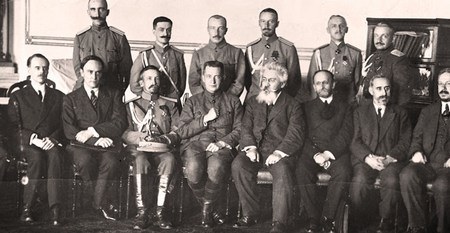 From March 1 to 3, 1917, news of the revolution’s victory in Petrograd and the overthrow of the monarchy spread through Odesa, leading to a peaceful transfer of power from the tsarist officials to the revolutionary democracy. On March 2, 1917, Odesa’s city governor, Boris Pelikan, issued an appeal to the population, urging “calm and order”.
Unlike in Petrograd, the coup in Odesa was bloodless: there were no street battles, shootouts, or mass arrests of “counter-revolutionaries.” Only a few of the most notorious figures of the old regime were arrested on March 7-8, 1917—city governor Boris Pelikan and his deputy L. Mechnikov, the head of the investigative police, Hirschfeld, and his deputies. In total, 14 people were arrested. Most of the old Odesa police officers were sent to the front, the gendarmerie was disbanded, and on the streets of Odesa, they were replaced by squads of people’s militia, consisting mostly of students, led by the head of the militia, university professor Zavyalov. Soon, a commission of inquiry headed by Senator S. Tregubov began investigating the corrupt, anti-democratic, and reactionary activities of the former city governors Tolmachov and Sosnovsky, and the former city governor Pelikan. In the early days of the revolution, the monument to Catherine II was covered with a large cloth—to avoid provoking the “revolutionary public”.
At a meeting of public representatives and self-government, convened by the acting Odesa city governor, General V. I. Esaulov, a new revolutionary governing body was established. Power in Odesa transferred to the revolutionary Provisional Government of Russia and the local Odesa Committee of Public Organizations, also known as the Civil Committee (an organ of the Provisional Government attached to the city Duma). All public and political organizations in the city sent their representatives to the Civil Committee. After the old city Duma was dissolved, the Civil Committee took over the administration of Odesa until the election of a new city Duma. Among the Ukrainian leaders, Ivan Lutsenko and Serhiy Shelukhin became members of the Civil Committee.
On the evening of March 6, 1917, the first session of the Odesa Workers’ Deputies Council took place in the “People’s Auditorium” (currently the “Rodina” cinema building). This gathering included 225 delegates from 50 factories and plants. During this session, an Executive Committee of 23 members was elected, primarily composed of representatives from the Menshevik and Bund parties, with three Bolsheviks among them. The head of the Executive Committee was I. Gnedenko. The Executive Committee soon expanded to 48 members, with seven Bolsheviks included. The Council delegated four deputies from the Menshevik and Socialist-Revolutionary parties (Gnedenko, Dudyuk, Feldman, and Borkun) to the Odesa Public Committee. The Odesa Council consisted of 1,015 deputies: 194 were Mensheviks, 232 were Socialist-Revolutionaries, 18 were Bolsheviks, 102 represented other parties, and 366 were non-partisan. Interestingly, slightly more than half of the Odesa Workers’ Deputies Council were actual workers, around 520, while the remaining deputies were intellectuals, employees, representatives of free professions, and the unemployed. The Odesa Council operated various departments, including those for workers, peasants, military affairs, finance, agitation, publishing, legal matters, public safety, workers’ militia, the Red Guard, and municipal affairs. It also had commissions on mandates, provisions, and audits. The new Council sent a congratulatory telegram to the revolutionary Provisional Government in the capital, celebrating its victory over the “dark forces of the country.” The next day, the Vorontsov Palace began flying the red revolutionary flag, and by March 18, the palace had become the “revolutionary headquarters” of Odesa. New newspapers like “Izvestia of the Odesa Council” and “Southern Worker” (the organ of the Odesa RSDLP Committee) started publishing, with Mensheviks running the editorial staff. On March 17, workers in Odesa began implementing an eight-hour workday at enterprises, which was officially endorsed by the authorities on March 20, 1917.
On March 12, 1917, the Soldiers’ and Officers’ Deputies Council was organized, chaired by the Socialist-Revolutionary, Captain of the battleship “Sinop,” and First-Rank Captain O. Zarudny. The Sailors’ and Officers’ Deputies Council soon merged with the Soldiers’ Council. Around this time, other councils formed, including the Council of Labor Intellectuals and the Peasants’ Council of the Odesa District. In May 1917, at a meeting of the Odesa Executive Committee of the Councils, Alexander Kerensky (one of the leaders of the Provisional Government) proposed a broad coalition of forces and the unification of workers’, soldiers’, and peasants’ councils. Of the 911 members of the Odesa Workers’ Deputies Council who declared their party affiliation, 232 were Socialist-Revolutionaries, 194 were Social-Democratic Mensheviks (from various factions), 18 were from the Bolshevik faction, 102 were from other parties, and 366 were non-partisan. Workers made up 520 members of the Odesa Workers’ Deputies Council, while intellectuals and employees accounted for 391.
On March 11, during the 17th session of the Civil Committee, engineer and Cadet Mikhail Braykevich was elected as the new “temporary” city governor, with Menshevik V. Bogutsky as his deputy. The revolutionary governor was General D. Ebel, head of the Odesa Military District, with General U. Esaulov as acting city governor and Professor D. Mikhailov as police commissioner. The city commandant became the Socialist-Revolutionary ensign, Ryazanov. Simultaneously, necessary measures were taken to protect the gains of the revolution, including the formation of a Public Safety Commission that oversaw the protection of strategic facilities. Revolutionary students succeeded in removing the reactionary rector of Odesa University, D. Kishensky. All political prisoners were released from prisons. General D. Ebel (succeeded by General P. Felitsin in August 1917) was appointed commander of the Odesa Military District, and General Nikanor Aleksandrovich Marks, known in Odesa as the “red general,” became the district’s chief of staff. N. Kharito was appointed military commissar of the Provisional Government in Odesa, and M. Shreider became the naval commissar. On March 19, an Ukrainian Veche (assembly) was held in Odesa, attracting over 700 residents. The Veche was opened by Volodymyr Chekhivsky. Starting in March 1917, the journal “Ukrainske Slovo” (“The Ukrainian Word”) began publishing in Odesa, edited by the leader of the local Ukrainian Social-Democratic Workers’ Party, Volodymyr Chekhivsky. Odesa elected Ivan Lutsenko, I. Romanenko, Volodymyr Chekhivsky, Vsevolod Holubovych, Pelishenko, Kushch, and Chornota to the Ukrainian Central Rada. Serhiy Shelukhyn became the head of the Ukrainian Executive Committee. On April 13, the Odesa Provincial Ukrainian Rada was established, dominated by Ukrainian Social-Democrats and Socialist-Revolutionaries, with Volodymyr Chekhivsky as its head. On June 28, the Ukrainian National Congress was held in the city, attended by around 200 delegates from across the Kherson province.
In the early days of March, the gates of the Odesa prison were opened for several hundred political prisoners. Yakovlev, the prosecutor of the Odesa Judicial Chamber, and Kondratyev, the prosecutor of the Odesa District Court, personally carried out the order of the Minister of Justice of the Provisional Government, Alexander Kerensky, announcing the revolutionary minister’s telegram to the political prisoners and personally conveying to each freed individual “greetings on behalf of the minister.” On March 8, 1917, a rebellion broke out in the Odesa prison. The result of the uprising led to new “revolutionary” prison rules. Newspapers at the time reported: “All cells are open. Inside the compound, there are no guards. Complete self-government of the prisoners has been established. The prison is led by Hryhoriy Kotovsky and the assistant lawyer Zvonkin. Kotovsky kindly conducts excursions around the prison” In March 1917, in the “Saratov” café, 40 criminal “authorities” from Odesa and the surrounding region held their conference. At that time, Kotovsky proclaimed: “We have been sent from the prison castle to call everyone to unite in support of the new order. We need to rise, earn trust, and be freed. There is no danger to anyone from this; we want to abandon our craft and return to peaceful work.” On behalf of the thieves, he appealed to the Odesa authorities, asking to send all criminals to the front “to defend the revolutionary homeland.” On April 30, Kotovsky sent a new request to the prosecutor, asking to be amnestied as a political prisoner and sent to the front. On May 5, 1917, Kotovsky was finally conditionally released, with the condition of immediate deployment to the front.
On May 10, 1917, the First Congress of the Soviets of the Romanian Front, Odesa District, and Black Sea Fleet opened in Odesa, attended by Alexander Kerensky (then the Minister of War) and Alexander Kolchak (then the revolutionary commander of the Black Sea Fleet).
In April 1917, Red Guard units began to be formed at the city’s factories. They acted as a workers’ militia to protect the revolutionary gains from counterrevolution and defend against pogroms. Initially, these units were loyal to the authorities and were led by Mensheviks, Bolsheviks, and Socialist-Revolutionaries.
At the same time, a movement for the Ukrainization of the army began to form in Odesa, leading to the creation of the local Ukrainian Military Council headed by I.A. Lutsenko. This council included delegates from the soldiers of the Odesa garrison and sailors of the Black Sea Fleet. In June, permission was obtained to form Ukrainian army companies, and in August, the first Ukrainian Haidamaky regiment was established, led by Lieutenant Colonel V.R. Poplavko.
From May 10 (May 23) to May 27 (June 9), 1917, at the First Frontline and Regional Congress of Soviets held in Odesa, the Central Executive Committee of the Soviets of the Romanian Front, Black Sea Fleet, and Odesa—Rumcherod—was elected. The majority of the first Rumcherod assembly consisted of Socialist-Revolutionaries and Mensheviks. Rumcherod aimed to become a governing body in the “frontline regions” and sought to control not only the army and navy of the Romanian front but also the lands of Bessarabia and Odesa.
In the summer of 1917, due to the release of many criminals from prison, banditry in Odesa reached alarming proportions. The disintegration of the army led to the appearance of tens of thousands of deserters in Odesa and its surroundings. Soldiers were selling weapons brought from the front, which contributed to the arming of gangs and various pseudo-revolutionary units. From August, Odesa was flooded with pogroms of shops and warehouses, robberies, and shootouts. Ideological anarchists carried out spontaneous expropriations of the bourgeoisie.
The Kornilov Affair, aimed at establishing a military dictatorship and “restoring order,” did not bypass Odesa. General M. Marks, the chief of staff of the Odesa district (later the military district) openly opposed the coup. From August 28 to September 4 (old style), a coalition Temporary Revolutionary Committee operated in Odesa, consisting of representatives from the Odesa Council, Rumcherod, municipal self-government, Ukrainian and Jewish socialist parties, Socialist-Revolutionaries, Mensheviks, and Bolsheviks. The Revolutionary Committee controlled the security of important objects, organized arrests of “suspicious counter-revolutionaries,” and shut down the “right-wing” newspaper “Southern Rus’.” The fight against Kornilov’s supporters led to the rise of the Bolsheviks’ authority, the “Bolshevization” of the councils, and the gradual transition of Red Guard units under Bolshevik control.
At the same time, the positions of the Central Rada were strengthening. Its supporters formed three Haidamaky regiments, a cavalry Haidamaky regiment, and Ukrainized an artillery battery and a machine gun regiment. In October, the Ukrainization of the headquarters of the Odesa Military District, the artillery and infantry schools, and several reserve regiments began. Soldiers supporting the Central Rada were organized into the Odesa Haidamaky Division (about 6,000 soldiers). Ukrainian flags were also raised on the destroyer “Zavidny” and the cruisers “Pamyat’ Merkuria” and “Svetlana,” which were stationed in the Odesa port and on the roadstead.
The news of the October Revolution in Petrograd caused panic among Odesa’s residents and aggression among radicals. Bolsheviks, left Socialist-Revolutionaries, anarchists, and maximalists began demanding the establishment of a “proletarian dictatorship” in Odesa. However, Rumcherod, where the Menshevik-Socialist-Revolutionary majority still held sway, condemned the events in Petrograd. The Odesa Ukrainian Rada (following the Kyiv Central Rada) also condemned the Petrograd events, while the Odesa Council took a neutral stance.
Ukrainian People’s Republic
On November 7 (20), 1917, in Kyiv, the Third Universal was adopted by decision of the Little Council, proclaiming the creation of the Ukrainian People’s Republic (UNR) in federative association with the Russian Republic. It was announced that the territories where Ukrainians made up the majority of the population, including the Kherson Governorate and Odesa, were to be part of the UNR.
To maintain order in Odesa, a coalition regional Revolutionary Committee was reformed, comprising representatives of the Council, Rumcherod, the Ukrainian Council, leaders of the Odesa Military District (OVO), and leaders of socialist parties. The Revolutionary Committee decided on the inclusion of Odesa in the UNR. The authority of the Central Rada in Odesa was exercised through the Ukrainian Provincial Council (headed by I.M. Lutsenko), the government commissioner of the UNR, Lieutenant Colonel V. Poplavko, and the head of the Odesa Revolutionary Committee, V. Chekhovsky. The Committee for the Protection of the Revolution under the Odesa Ukrainian Council established control over the city’s arsenals and strategic facilities. General N. Marks, the commander of the Odesa Military District, who had previously issued weapons from the district’s stockpiles to the Red Guard units, the workers’ militia, and Bolshevized garrison units, was forced to leave his post. The acting commander of the district, Major General H. Yelchaninov, supported Odesa’s Ukrainian orientation.
Rumcherod, having not supported the Bolshevik uprising in Petrograd, did not recognize the supreme authority of the Central Rada over southern Ukraine. A similar stance was taken by the majority of the Odesa Council, the city Duma, the local organizations of the Bolsheviks, Mensheviks, anarchists, Socialist-Revolutionaries, and the Jewish Bund.
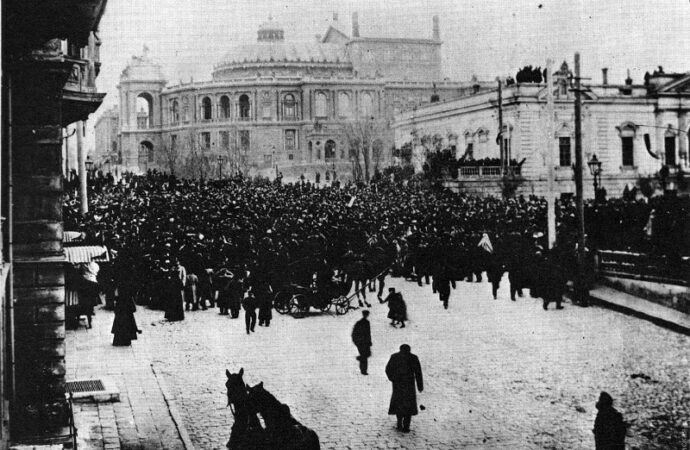
General D.G. Shcherbachov, the de facto commander of the armies of the Romanian front, managed for some time to hold back the disintegration of the front’s troops caused by the influence of revolutionary events and Bolshevik agitation. He succeeded in having the Front Committee pass a resolution on October 30 (November 12), declaring non-recognition of Soviet power. In November, Shcherbachov supported the Central Rada’s decision to unite the troops of the Southwestern and Romanian fronts of the former Russian Imperial Army into a single Ukrainian Front and was appointed commander of the Ukrainian Front of the UNR army.
On the night of December 1 (14), due to rumors that the Odesa Red Guard was about to be disarmed by the Haidamak forces, up to 300 Red Guards and sailors occupied the train station and seized the garage of the Central Rada’s forces. The Red Guards also attempted to incite the Serbian units stationed in Odesa against the Central Rada and to storm the headquarters of the military district. Naval personnel from the cruiser Almaz, which housed the headquarters of the uprising, supported the Bolsheviks and tried to seize the English Club, which was the meeting place of the Odesa Ukrainian Council. To repel the uprising, “Haidamak” units—armed formations of Central Rada supporters—were sent to the city center.
Shootouts between the Haidamaks and Red Guards began to break out in central Odesa, near the train station and the district headquarters. The insurgents failed to capture strategic objects or to drive the Ukrainian units out of the city. On December 3 (16), 1917, four echelons of Central Rada troops arrived in Odesa. To stop the bloodshed, a “reconciliatory” Temporary United Committee of Councils was created, composed of representatives from the Odesa Council, the Odesa Ukrainian Council, and the Temporary Revolutionary Bureau, which included representatives from Rumcherod, the district headquarters, the Central Rada, and the commissar of the Provisional Government. After this, Central Rada troops took control of all strategic objects in Odesa.
Following a directive from the Soviet Supreme Commander M.V. Krylenko on December 3 (16), 1917, the first convocation of Rumcherod was dissolved. The Second Frontline and Regional Congress of Soviets, held in Odesa from December 10 to 23, 1917 (December 23, 1917 – January 5, 1918), opposed the Central Rada, recognized Soviet power, and elected a new composition of Rumcherod, which included 70 Bolsheviks, 55 Left Socialist-Revolutionaries, 23 representatives of peasant organizations, and 32 representatives from other factions. V.G. Yudovsky was elected chairman of the Rumcherod executive committee. Rumcherod declared itself the supreme authority in the Southwestern Region (Bessarabia and Kherson Governorate) and on the Romanian front, assuming control over all revolutionary military units of the front. In October 1917, Odesa became part of the UNR, but its political and legal status within the Ukrainian state remained contentious—at least until its final occupation by Bolshevik forces. “The situation became clearer after the proclamation of the UNR. The publication of the Third Universal was of great importance for the establishment of the system of power in Odesa, as local Ukrainian organizations began to more decisively assert their demands regarding the governance of the region, following the directives of the Central Rada” – noted T. Vintskovsky
On December 4 (17), 1917, the Soviet People’s Commissariat of Soviet Russia sent the “Manifesto to the Ukrainian People with Ultimatum Demands to the Central Rada” to the First All-Ukrainian Congress of Soviets, in which it declared non-recognition of the Ukrainian Central Rada and demanded an end to the disarmament of Soviet regiments, as well as cooperation with revolutionary troops in their struggle against the counterrevolutionary Kadet-Kaledin uprising.
Meanwhile, during the period of December 4-11 (17-24), under orders from Petliura and General Shcherbachov, troops loyal to the Central Rada captured the headquarters of the Romanian and Southwestern fronts, armies, and regiments, arrested members of the military-revolutionary committees and Bolshevik commissars, some of whom were executed. This was followed by the disarmament and disbandment of units by the Romanians where Bolshevik influence was strong. Russian soldiers were left without weapons and supplies, and some of them decided to return to Russia on foot.
The quasi-state entity “Odessa Soviet Republic”
On January 3 (16), 1918, the Odesa Council of Workers’, Soldiers’, and Sailors’ Deputies passed a resolution declaring Odessa’s self-determination as a “free city” with an autonomous government.
January 4 (17), the People’s Secretariat of the Ukrainian Socialist Soviet Republic, formed in Kharkiv, officially declared war on the Central Rada.
On January 9 (22), facing the advance of Soviet forces, the Ukrainian Central Rada issued the Fourth Universal, proclaiming Ukraine’s independence.
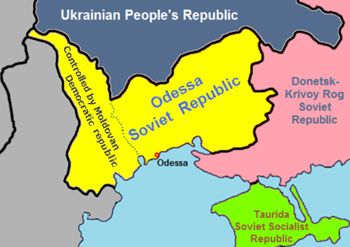 On January 13 (26), 1918, an uprising began in Odessa, led by the Military-Revolutionary Committee of Rumcherod (headed by V.G. Yudovsky), which included representatives from factory committees, Bolsheviks, Left SRs, Maximalists, and anarchists. By the morning of January 14 (27), the insurgents had seized the military district headquarters, the railway station, the telephone exchange, the post office, and the telegraph. That morning, the Odesa Revolutionary Committee published an address in the newspaper Golos Proletariya, stating that power in the city had “passed to the Soviets.” Approximately 2,300 Red Guards, members of Left SR and anarchist combat organizations, around 2,000 sailors from the battleships Sinop and Rostislav, the cruiser Almaz, 1,000 Bolshevized soldiers from the 49th Regiment and the Okhtyrka Machine Gun Regiment, the detachments of Mishka Yaponchik and Yashka Blyumkin, an internationalist detachment led by Olekо Dundich, formed from captured soldiers of the Austro-Hungarian army, and the Union of Youth detachment led by Semen Uritsky, all sided with the Bolsheviks. The Central Rada had 2,000 fighters in Odessa (two Haidamak battalions with 1,300 bayonets, 200 cadets with bayonets, and separate detachments, including gymnasium students and university students, with 300 bayonets). Several military units of the garrison declared their neutrality.
On the morning of January 15 (28), the Haidamak units and cadets, supported by armored vehicles, began an offensive from the area of Velykyi Fontan, where the Haidamak barracks were located, toward the city center and the railway station. They managed to retake the railway station, the district headquarters, and occupy the central part of the city up to Soborna and Hretska Squares and the port. The Bolsheviks took up defensive positions around the Red Guard and Revolutionary Committee headquarters on Torgova Street. By evening, the insurgents held only the working-class outskirts, the port, and part of the city center.
However, on January 16 (29), the cruiser Rostislav and an armored train seized by the Bolsheviks began artillery shelling of the Haidamak positions, and reinforcements joined the battle on the side of the insurgents—a combined battalion of the 6th Army of the Romanian Front (500 bayonets). They struck the Ukrainian forces from the rear—from the direction of Velykyi Fontan.
On January 17 (30), the insurgents retook the railway station, the district headquarters, and surrounded a significant part of the Haidamaks in Oleksandrivskyi Park. Faced with the futility of further resistance, the Central Rada troops requested a truce, and on January 18 (31), they were withdrawn from Odessa. At Rozdilna station, most of the Haidamaks were disarmed by a Bolshevik detachment.
In the first days after the uprising’s victory, Odessa was ruled by the Revolutionary Committee, and on January 25 (February 7), new elections were held for the Executive Committee of the Council of Workers’ Deputies. The new composition of 75 members included 36 Bolsheviks, 10 Left SRs, 9 “Left” Mensheviks and Bundists, and 5 anarchists, with Bolshevik O. Voronsky appointed as the head of the presidium.
On January 29 (February 11), at a joint meeting of the Council of Workers’ Deputies and Rumcherod, the Odessa Council of People’s Commissars (composed of representatives of the Bolsheviks, anarchists, and Left SRs) was established, and the “Odessa Soviet Republic” was proclaimed, recognizing the supreme authority in the form of the Council of People’s Commissars of Soviet Russia. V.G. Yudovsky was elected chairman of the Council of People’s Commissars of the Odessa Soviet Republic (CPC OSR).
The new authorities closed most newspapers, radically changed the administrative apparatus, and began a wave of confiscations and arrests of “counter-revolutionaries”. Their actions provoked a “massive class terror” against the nobility, bourgeoisie, clergy, officers, and former police officers. The Odessa CPC established a “Bureau (Commission) for Combating Counter-Revolution” and a revolutionary tribunal. The warships Rostislav and Almaz, stationed in Odessa’s harbor, were converted into floating prisons where detainees were tortured and executed without trial.
Odessa’s criminal elements, who had participated in the overthrow of the Central Rada’s authority, behaved as victors and “masters” of the city. Under the guise of “revolutionary mandates”, they openly looted private homes, banks, shops, enterprises, and warehouses. On January 22 (February 4), with the complicity of the Soviet authorities, bandits attacked the premises of Odessa’s judicial police, burned down the “Registration Bureau” with its records of all the city’s criminal elements, and killed its employees. The criminal leader Mishka Yaponchik led a Jewish combat detachment, which later became part of the “Odessa Soviet Army” as the “reserve of the government” and command, and was placed on the state payroll.
The “Odessa Soviet Republic” was proclaimed within the territories of the Kherson and Bessarabian Governorates, but the actual power of its government extended only to Odessa, as well as the Odesa, Ananyiv, and Tiraspol districts. Meanwhile, Romanian troops continued the creeping annexation of Budjak—the southern part of Bessarabia (Izmail and Akkerman districts)—which began on January 10 (23) when the Romanians occupied Bolhrad.
On January 22 (February 4), Romanian troops captured the district town of Izmail, and on January 25 (February 7) took the town of Kiliya; on February 15, they occupied Vylkove. Several warships from Odesa and Sevastopol carrying revolutionary sailors and Red Guards (1,000 bayonets) were dispatched to the Danube. The fleet operating against Romania was commanded by the Baltic sailor-anarchist Anatoly Zheleznyakov, who also headed the revolutionary headquarters of the Danube Flotilla.
On January 23 (February 5), the Rumcherod declared war on Romania. The “Special Odessa Army,” hastily formed and numbering about 4-5 thousand men under the command of the Left SR Pyotr Lazarev, was positioned on the left bank of the Dniester from Ovidiopol to Rybnitsa. This army included separate revolutionary Odessa units—mainly Bolsheviks, Left SRs, and anarchists—as well as small remnants of the old army that had broken through from the Romanian front to the Dniester.
On February 14, the Soviet commander, Left SR Mikhail Muravyov, who had a week earlier led Soviet troops of the Ukrainian SSR to drive the Central Rada out of Kyiv, was appointed commander of the front against Romanian forces in Bessarabia and Transnistria. The Soviet government of the RSFSR tasked him with not only preventing Romanian troops from reaching Odessa but also capturing the entirety of Bessarabia and bringing it back under Soviet Russian control. The dictatorial powers granted to Muravyov by the Bolsheviks limited the authority of the Odessa Soviet Government (RNCOR).
Within a day, Muravyov’s three-thousand-strong army was transferred from near Kyiv to the Dniester. Romanian forces had already reached the town of Bendery, and in some areas had crossed to the left bank of the Dniester, attempting to establish a foothold there, but were pushed back by the “Special Odessa Army” units, prompting them to request a ceasefire.
Upon Muravyov’s arrival in Odessa, hostilities resumed. On February 20, Muravyov launched an offensive near Bendery. The Bolshevized units of the 8th Army, which had arrived earlier, were ordered to advance along the Bălți-Rybnitsa line. By March 2, Muravyov’s forces had defeated the Romanians in Rybnitsa and Slobodzeya, thwarting their attempts to gain a foothold in Transnistria. Muravyov proposed to the Soviet leadership that they continue the offensive with his army towards Chișinău or Iași, or transfer 2,000 soldiers to Akkerman and advance on Izmail.
Under the pressure of military failures, the Romanian command offered a truce. Peace negotiations took place in Odessa and Iași. A joint protocol was signed to cease the Soviet-Romanian armed conflict, under which Romania committed to withdrawing its troops from Bessarabia within two months and refraining from any military or hostile actions against the RSFSR. On March 8, Soviet troops received orders to cease hostilities against Romanian forces. However, the Romanian authorities understood that Austro-German troops, which had begun occupying Ukraine between February 18 and 25 under an agreement with the Central Rada, and had already taken Kyiv and Vinnytsia, would soon reach Odessa. Thus, on March 9, Romania, in violation of the agreements reached, seized Akkerman, completing the occupation of southern Bessarabia, and within a few days, annulled the signed documents.
On February 24, with the onset of the Austro-Hungarian invasion of Ukraine’s territory under an agreement with the Central Rada, Muravyov declared martial law in Odessa and ordered the destruction of all wine warehouses. Attempting to establish a regime of personal military dictatorship in Odessa, he dissolved the city council, banned meetings and gatherings, and imposed strict censorship.
By March 3, the Austro-Hungarian forces, having captured Podillia, reached Balta, threatening the rear of the Southern Soviet armies. Commander Muravyov ordered the 3rd Army units to halt the advance of the Austro-Hungarian forces along the line of the Southwestern Railway and to close the front from the Dniester to Birzula, Pomichna Station, and Znamianka Station.
On March 5-7, near the Słobidka and Birzula stations, the Red forces attempted to stop three infantry and two cavalry divisions of the 12th Corps of the Austro-Hungarian Army advancing on Odessa. However, the outnumbered and poorly organized units of the 3rd Army eventually retreated. In Odessa, meanwhile, soldier riots broke out, accompanied by looting of shops and wine warehouses. After capturing the Birzula station, the Austro-Hungarian troops attacked the Rozdilna station, just an hour’s drive from Odessa. The general mobilization declared by the Bolsheviks in Odessa did not yield the expected results, and the workers’ and party members’ combat units were few in number. Commander Muravyov acknowledged: “The defense of Odessa has become impossible. The city has produced only 500 Red Guards, while there are 120,000 proletarians in the city… and the regular troops refuse to fight“. On March 11, the Soviet forces abandoned their defensive positions 10 km from the city and fled to Odessa. The Odessa Council, by a large majority, proposed surrendering the city without a fight, citing the population’s passivity. The Rumcherod also recognized the defense of Odessa as futile. Muravyov was forced to order a retreat. On March 12, the city council took control of Odessa and negotiated with the Austrian command for the unimpeded evacuation of the Red armies. On March 13, units of the Austrian army entered the city without a fight. Following them, the troops of the Central Rada also entered Odessa. The “Odessa Republic” ceased to exist. The Soviet authorities were evacuated to Sevastopol along with archives, valuables, and military equipment..
UNR – Ukrainian State – UNR (Directorate). Austro-German Occupation. Entente Forces. White Movement
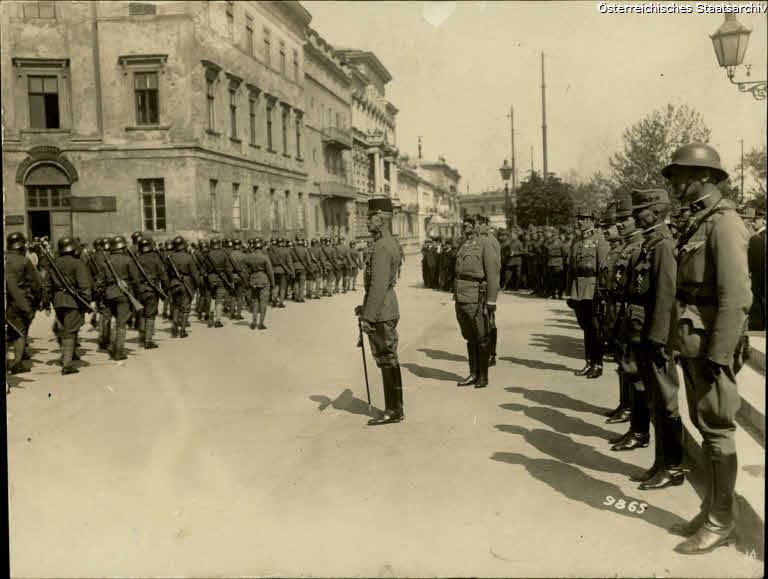 Thanks to the introduction of Austro-German troops into Ukraine, the Ukrainian Central Rada regained control of the country. However, in the situation of “dual power” that arose due to the occupation of Ukraine, their authority was quite nominal. Nonetheless, political rallies were banned, several leftist newspapers were shut down, censorship was introduced, and the activities of trade unions and councils were limited. In Odessa, as throughout Ukraine, any agitation against Austro-German troops, the Central Rada, and the Ukrainian Government was prohibited.
Under Hetman Skoropadskyi, Odessa was separated from the Kherson Governorate as a distinct administrative unit—the city governorate. The councils were dispersed, most trade unions and liberal zemstvos were closed. Both “leftists” and supporters of the Entente—the so-called “defenders”—were arrested. Odesa suffered from growing unemployment, hunger, rationing, and a cholera epidemic. The Austro-German command uncontrolledly exported food, raw materials, and equipment from the Odessa region. Despite strict prohibitions, a powerful strike movement was noted (leather factories and bakeries in May 1918, a general railway strike in July).
The local branches of the Ukrainian Socialist-Revolutionary Party (UPSR) and the Ukrainian Social Democratic Workers’ Party (USDRP) were in opposition to the Hetman’s regime. In the summer of 1918, the leaders of the Ukrainian socialists in Odessa began preparing an uprising against Hetman’s rule. The organizers of the uprising were I. Lutsenko and V. Chekhivskyi.
In Odessa, a public commission was established to investigate the crimes of the Bolsheviks during the period of the “Odessa Soviet Republic.” Dozens of corpses of tortured “counter-revolutionaries” were raised from the bottom of the bay.
At the same time, a significant underground movement, oriented towards the Bolsheviks, left Socialist-Revolutionaries, anarchists, and maximalists, operated in Odessa. The underground engaged in anti-Hetman agitation and carried out acts of terror. For instance, the explosion at military artillery depots in Blyzhni Mlyny killed and injured up to 700 Odessa residents, leaving 4,000 people homeless. Due to this explosion, in mid-October, all employees of the Soviet consulate in Odessa were detained, and about 200 Soviet diplomats and citizens were expelled. At the same time, there were mass arrests among the local Bolshevik underground in Odessa.
The Bolsheviks and anarchists provided financial and organizational support to the advancement of the “king of thieves” in Odessa, their man—the “revolutionary” Mishka Yaponchik. Apparently, by October 1918, Yaponchik controlled the outskirts of Odessa, primarily Moldavanka, and criminal elements, which numbered up to twenty thousand people in Odessa.
During the period of the Ukrainian State, a strong Austro-German garrison was stationed in Odesa. The Austrian occupation troops in Ukraine were commanded by General von Beltz (from June 1, 1918 – military governor of Odesa). Later, on November 9, 1918, after learning about Austria-Hungary’s defeat in World War I and the collapse of the empire, the general shot himself in his office.
In 1918, Polish military formations were created in the city. On April 13, 1918, the Minister of War of the UNR, Oleksandr Zhukovskyi, ordered the disbanding of all Polish military units in Odesa. However, the Poles did not comply with the order; Austro-Hungarian troops came to the aid of the Ukrainians, presenting the Poles with an ultimatum regarding disarmament, and on April 20, 1918, the Polish detachment in Odesa was disbanded.
On April 17, 1918, the formation of the 3rd Odesa Corps of the UNR armed forces began in Odesa and the territory of the Kherson Governorate (after Hetman Skoropadskyi’s coup on April 29, 1918 – the Ukrainian State). From July 8, the corps was renamed the 3rd Kherson Corps. The regiments of the corps were Ukrainianized. Directly in Odesa and Transnistria, three regiments of the 5th Infantry Division of the 3rd Kherson Corps were stationed.
In mid-November 1918, Ukraine rose up against Hetman Pavlo Skoropadskyi. Germany and Austria-Hungary, his recent allies, having lost the war, capitulated to the Entente countries and began the hasty withdrawal of troops from Ukraine.
On November 14, 1918, a few days after the news of Germany’s capitulation, Hetman of Ukraine Skoropadskyi signed the “Charter”—a manifesto in which he declared that he would defend the “ancient power and strength of the All-Russian state,” and called for the construction of an All-Russian federation as the first step towards the restoration of a great Russia. The manifesto marked the collapse of all efforts of the Ukrainian national movement to create an independent Ukrainian statehood. This document finally alienated the majority of Ukrainian federalists, military personnel, and intellectuals from the Hetman. An anti-Hetman uprising led by the UNR Directorate unfolded in Ukraine.
On November 22, 1918, an Entente representative informed Hetman Skoropadskyi that the allies would soon provide him with military assistance to protect against Soviet Russia and suppress unrest in Ukraine. At the same time, the French command made it clear that it aimed to restore a “strong united Russia” with Ukrainian lands as part of it, and thus the French primarily supported the White Movement. The command of the Entente armed forces considered southern Ukraine and Crimea as crucial strategic bases for a future offensive on Moscow, but they were in no hurry to deploy their troops and start a military campaign.
The uprising against the Hetman regime led to a split in the army of the Ukrainian State between supporters of Skoropadskyi and supporters of the Directorate. Most of the officers of the 5th Division, stationed in Odessa, were hostile towards the Ukrainian government and aligned themselves with the Russian Volunteer Army under General Denikin, supporting the “one and indivisible Russia.” These officers were led by Corps Commander A.I. Berezovskyi. A smaller group of officers, mostly young Ukrainian officers who supported the Directorate, was led by I.M. Lutsenko. On the side of the Directorate were the newly formed 1st and 2nd Odessa Infantry Regiments and the Sloboda Infantry Regiment, Odessa student companies, several local volunteer units, and others. Meanwhile, Berezovskyi announced the integration of part of the 3rd Corps and the entire Odessa military district into the Volunteer Army.
On November 26, the first British destroyer appeared in the roadstead of the Odessa port. On November 29, a train carrying Serbian troops (800 soldiers) arrived in Odessa, where a strong garrison of Austro-German troops still remained, followed two days later by Polish legionnaires (1,000 soldiers). On December 2, the French battleship “Mirabeau” arrived in Odessa. Between December 7 and 10, a French division with artillery (up to 3,000 troops) landed in the Odessa port.
By that time, the insurgent detachments and Hetmanate troops that had switched sides to support the Directorate of the Ukrainian People’s Republic (UNR) controlled most of Ukraine, completely blockaded Kyiv, and had almost effortlessly captured towns near Odessa: Balta, Ananiv, and Birzul. On December 10, they approached Odessa closely. Realizing that Skoropadskyi no longer controlled the situation, the Allied command decided to “freeze” the preparations for an offensive on Kyiv to assist the Hetmanі.
Fearing that Odesa might fall completely under the control of Allied forces and White Guard volunteers, Ivan Lutsenko and his chief of staff, military officer Vsevolod Zmiienko, on December 7, 1918, issued an ultimatum to Berezovsky to immediately transfer Odessa to the Directorate’s troops. The Hetmanate forces near Odessa were unable to even temporarily delay the advance of the Petliurists. After the Austrian troops left Odessa in early December, the city’s authority was maintained only by small and weak officer detachments led by General V. Biskupsky, numbering up to 1,000 bayonets.
On December 11, 1918, the advance units of the Directorate’s army entered Odessa. The Hetmanate corps defending Odessa surrendered. The Directorate’s authority was established in Odessa. Russian volunteer units that tried to defend the city were driven to the port, where they began preparing to evacuate to Crimea on the passenger steamer “Saratov”.
Taking advantage of the temporary power vacuum in Odessa, Mishka Yaponchik organized an assault on the Odessa prison. As a result, about 700 prisoners, mostly criminals, were freed.
On December 12-13, 1918, the Directorate’s troops took control of all the strategic points of the city without a fight. The Petliurists left the Allied military command only a small seaside “Allied zone” in Odessa (the port, a few seaside quarters, Mykolayivski Boulevard).
On December 16-17, 1918, a new French landing force under General Borius (the 156th division—up to 5,000 bayonets, including two battalions of “colonial troops”—”zouaves”—Senegalese and Moroccan soldiers) disembarked in the Odesa port from newly arrived ships. Encountering hostile attitudes from the Petliurists, the French decided to clear Odesa using White officers.
French Consul Émile Henno and General Borius offered General A. N. Grishin-Almazov dictatorial power in Odessa on the condition that he ensure the expulsion of the Petliurists from the city. Grishin-Almazov accepted the offer and took command of the volunteer detachment formed on the “Saratov”.
On the evening of December 16, Grishin-Almazov’s detachment (2,000 fighters), which had landed in the port, engaged in battle with the Petliurists and began advancing toward the city center. They were joined by the Polish legionnaires (1,500 bayonets). The Grishin-Almazov detachment was provided with French officers, and they coordinated fire support from the Allied squadron. The newly formed Ukrainian garrison—a corps under the command of General D. V. Filatiev (no more than 2,500 fighters)—which lacked heavy artillery, opposed the White Guard officers. The naval artillery, which shelled the Petliurist positions for two days, forced the UNR units to abandon strategic positions.
On December 18, the French command issued an ultimatum demanding the Directorate withdraw its troops from Odessa. Symon Petliura, fearing a war with the Entente, ordered a halt to all military actions against its forces, insisted on the immediate withdrawal of troops from Odessa, and ordered them to retreat 40 km north of the city, where the Southern Front of the UNR army was established under the command of General A. Hrekov, the commander of the Directorate’s troops in Kherson, Katerynoslav, and Taurida provinces. According to V. Shulgin, General Borius, who had orders to occupy only Odesa, refused to pursue further advances and forbade the volunteer units from chasing the enemy.
On December 19, 1918, after the Petliurist troops withdrew, the French command announced that it was taking Odessa and the Odessa region “under its protection.” General Borius assigned Grishin-Almazov the duties of the military governor of Odessa and the “adjacent area” and thereafter did not interfere in matters of internal administration. Grishin-Almazov himself claimed to “rule” Odessa on behalf of the Volunteer Army and with the consent of the French command. However, the positions of General Denikin and his Special Council in Odesa were largely nominal, and Grishin-Almazov followed the will of the French military command of the Odessa region and was guided by the recommendations of his political adviser V. Shulgin. Grishin-Almazov formed his independent “Odessa government,” which dealt with local governance issues and even printed its own money.
In Odessa, all political parties and organizations were allowed to operate legally except for the Bolsheviks, anarchists, maximalists, left SRs, and left Ukrainian socialists. Simultaneously, political rallies and gatherings were banned, as was the activity of the Odessa Workers’ Deputies Council. Grishin-Almazov’s government pursued a policy of Russification. By decree, the teaching of the Ukrainian language, “Galician language,” was abolished in all educational institutions of Odessa. The “Little Russian language” was retained only as an “optional subject,” and the teaching of Ukrainian history and geography was replaced by the history and geography of “Southern Russia”.
The Special Council distrusted Grishin-Almazov, considering him a “pretender.” On December 28, 1918, Denikin sent his assistant, General O. Z. Lukomsky, to Odesa, who tried to persuade Grishin-Almazov to retain the council, which operated under him, only as an advisory body, without government functions. Denikin demanded that the Odesa “government apparatus” be disbanded altogether.
While the policy of the Entente in Odessa was determined by French “consul” Henno, the French command supported Grishin-Almazov’s Odessa “government,” and in January 1919, the idea of creating a regional Southwestern government in Odessa was even considered.
Meanwhile, by the end of December—early January, the number of French troops in Odessa had increased to 15,000. Despite the fact that there were up to 15,000 former Russian officers in Odessa, the officer detachment formed to maintain order in the city numbered only about 2,500 and could not be considered a combat-ready force.
Odessa was divided into control zones: volunteer, French, and Polish. The blockade of the 600,000-strong Odesa by the UNR army and the cessation of food supplies led to hunger and food riots. Odessa suffered from rampant inflation and mass unemployment. As Denikin noted in his memoirs, Grishin-Almazov persistently sought to expand the zone under French military control to the Tiraspol—Rozdilna—Berezivka—Mykolaiv—Kherson line, which would have created an excellent military-economic base, particularly due to the opening of a railway connection with Romania, where significant Russian property of the Romanian front remained.
Odessa was terrorized by bandits led by Mishka Yaponchik, who engaged in robbery, extortion, racketeering, and murder. Yaponchik supplied weapons to Bolshevik and anarchist underground members, ransomed political prisoners from jails, and helped eliminate provocateurs. Large-scale raids, accompanied by the seizure of weapons and summary executions of criminal elements without trial or investigation, involving French and Greek troops, were ineffective. The bandits repeatedly attempted to assassinate Grishin-Almazov himself, but he was saved by his personal guard—a Tatar cavalry unit led by Captain Bekirbek Maslovsky. Maslovsky’s subordinates also engaged in kidnappings and secret summary executions of people disliked by the dictatorial regime.
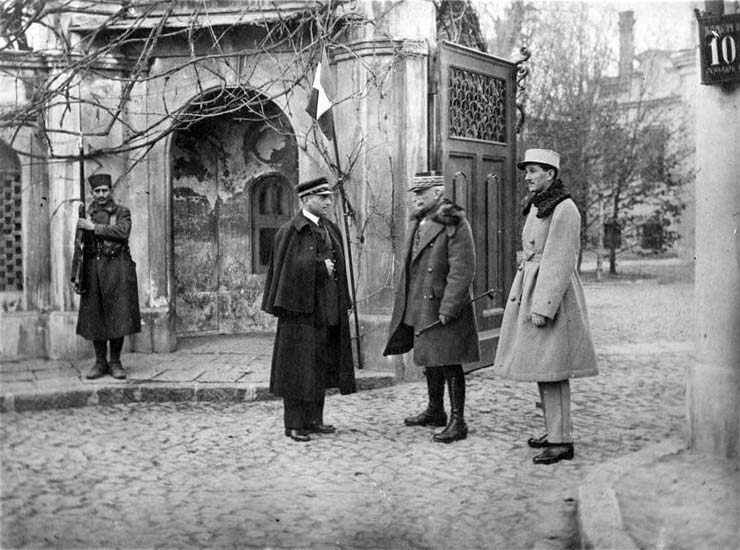 Since mid-January 1919, although Odessa was formally still governed by Hryshyn-Almazov, real power fell into the hands of French General Philippe d’Anselme, who arrived in Odessa on January 13 (commander of the Allied forces in Southern Russia) and Chief of Staff of the French forces in the South, Henri Freydenberg. Consul Émile Henno was removed from leadership.
The day after his arrival, d’Anselme received the Ukrainian mission led by General Hrekov. Following this, the French command, abandoning its orientation towards General Denikin’s White Army (whom the French considered a British protégé), began secret negotiations in Odessa and Birzula with representatives of the Directorate: S. Ostapenko, Minister of Foreign Affairs K. Matsievich, and General A. Hrekov.
НAt the end of January, the French shut down the newspaper “Russia” in Odessa (edited by V. Shulgin, political advisor to Hryshyn-Almazov), which had taken a sharply anti-Ukrainian stance and criticized the possible Ukrainian-French alliance. The French command also permitted the publication of Ukrainian newspapers in Odessa.
General d’Anselme demanded that Ukrainian forces unblock the area around Odessa and retreat to the Tiraspol-Birzula-Voznesensk-Mykolaiv-Kherson line, freeing up a military-economic bridgehead for the French forces capable of feeding the population of Odessa and a 50,000-strong military group. The Directorate was forced to comply with this demand as a necessary condition for starting negotiations on an alliance with the Entente. In the east, the invaders planned to advance towards Novyi Buh, Beryslav, Alyoshky, and Skadovsk, intending to consolidate (jointly with the Crimean White Guards) on the Kherson-Perkop railway. On January 21, 1919, after receiving the Directorate’s consent to expand the controlled zone, French and Greek troops began occupying the designated territories, landing naval forces, and advancing along the railway towards Kherson and Birzula. On January 25, occupation troops landed in Mykolaiv, and on January 29-30, in Kherson. During the occupation of Mykolaiv and Kherson, the French allowed the local Directorate authorities to coexist with French commanders. Formally, the Mykolaiv-Kherson region remained under the authority of the Directorate. In the Dnipro estuary area, the allies joined forces with the White Guard Crimean-Azov army. Concessions to the invaders by the Directorate put Hryhoriev, the commander of the Kherson Division of the UPR Army and who considered himself the sole master of the Mykolaiv-Kherson region, in a difficult position, leading to his defection to the Red Army.
The French proposed temporarily dividing Ukraine into two parts. It was envisioned that the Directorate of the UPR would govern Ukraine proper, while the South Russian region (the Black Sea coast with Odessa as its capital), occupied by French troops, would have its own government. In the South Russian region, it was planned to create a mixed (French-Russian-Ukrainian) army, which would also include Greek and Romanian units. After the war, France hoped to obtain a concession on Ukrainian railways and secure the repayment of all French debts.
On February 17, 1919, Symon Petliura appealed to the French command for help “to liberate the Ukrainian nation and restore the Ukrainian state.” General d’Anselme set conditions for the “government of the Ukrainian zone”: the resignation of Petliura and Andriievskyi, the establishment of French control over Ukraine’s finances and railways, the subordination of UPR troops to the general command of the Entente, the signing of a general military treaty between the Entente, Denikin, and the Directorate, and more. Under these conditions, France could support the creation of an alliance between Ukraine, Poland, and Romania, provide military and material assistance, and facilitate the recognition of the Ukrainian delegation at the Paris Peace Conference. However, an agreement was never reached, and by mid-March, due to the actions of the Red insurgents and the Soviet Ukrainian Front, the Odessa zone was cut off from the UPR territory.
Starting in December 1918, Odessa became a center of Bolshevik agitation and intelligence activities. The underground regional committee of the Communist Party (Bolsheviks) of Ukraine, led by Ivan Smirnov (Mykola Lastochkin), the Bolshevik “Foreign Collegium,” and the anarchist “Foreign Group,” which agitated among the troops of the Entente, were active there. The collegium included former Russian emigrants in France, Bolsheviks, and anarchists—V.O. Dyogot, Y.L. Yelin, S.I. Sokolovska, among others. Georges de Lafargue, the French communist Jeanne Labourbe, who worked with French soldiers of the 176th and 153rd Infantry Regiments, and the crews of the warships “Rénan,” “Jean Bart,” and “Justice,” were sent to Odessa with specific tasks. Lafargue was instructed to determine the possibility of peacefully ending the intervention, establish the strategic intentions of the Entente countries, their goals, territorial demands, and infiltrate the headquarters of the main French command in Odessa.
The Ukrainian Confederation of Anarchists “Nabat” had its underground cells in Odessa. In December 1918, Hryhorii Kotovsky, the commander of an anarchist Zehtser’s sabotage and terrorist group, appeared in Odessa. Zehtser’s unit engaged in the killing of provocateurs, extortion of money, and robberies. On February 17, 1919, a bomb was set off in the officers’ staff car.
The Soviet Russian government hoped that through anti-war propaganda and agitation among the French and Greek soldiers, for which significant funds were allocated, it would be possible to disrupt the Entente’s plans for a large-scale intervention.
In March 1919, the French counterintelligence and “White” counterintelligence under the command of Orlov-Orlinsky liquidated the entire Bolshevik underground—members of the “Foreign Collegium” were captured and executed without trial, de Lafargue was arrested and executed, and the leader of the underground, M. Lastochkin, was arrested and killed.
By February 1919, the forces of the Entente and White Guards in the Odessa-Kherson area had significantly increased. Up to 45,000 military personnel were concentrated there (including up to 25,000 French troops, armed with 22 tanks, 12,000 Greeks, and 3,400 Polish volunteer legionnaires as part of the 4th Polish Division of General Żeligowski). Units of the 40th Romanian Corps, numbering up to 1,000 bayonets, occupied the front from the Dniester to Rozdilna. At the beginning of February, 3,000 French and Greek troops were stationed in Kherson and Mykolaiv, and up to 5,000 in Odessa. Small detachments of 30-50 men were stationed at all railway stations from Odessa to Kherson; larger ones, such as Kolosivka, Rozdilna, and Berezivka, had 400-500 fighters. The Entente forces occupied an extensive front along the Mykolaiv-Kherson railway (up to 8,000 soldiers, 20 guns, 18 tanks, 4 armored cars, 5 airplanes).
The requisitions of food from the peasants of Odesa County, which began at the end of 1918 by Hryshyn-Almazov’s detachments and French troops, led to a peasant uprising in February 1919 in the Bilaivka-Mayaky-Yasky area. The rebel peasants captured Ovidiopol. Numerous peasant detachments appeared in some areas of Ananiv and Tiraspol counties. It reached the point where a partisan detachment of 200 men captured Tiraspol. In February 1919, the insurgents seized Bilaivka and the Mardarivka station, and the insurgents of the Tylyhulo-Bereziv and Ananiv detachments attacked the White Guard and interventionist units.
Alarmed by the situation, Denikin appointed Lieutenant General A.S. Sannikov as the Chief Governor and Commander-in-Chief of the troops of the Southwestern Region (Kherson Governorate and Odessa) at the end of January 1919, tasked with re-subordinating the local White Guard detachment of the Volunteer Army. However, d’Anselme and Freydenberg received the general, who arrived from Katerynodar, extremely coldly and insistently recommended that he leave Hryshyn-Almazov, who, although dependent on Sannikov, remained the military governor of the Odesa district. Meanwhile, the French command actively discussed with the “southern public circles” the idea of creating an independent Southwestern regional government and a mixed Franco-Russian-Ukrainian army (from the local population with French officers) for a campaign on Kyiv and Moscow. In connection with this, mobilization of the population into the Volunteer Army was banned in the “Odessa zone,” and the formation of voluntary mixed Russian-French units not subordinate to Denikin was ordered. Learning of this, Denikin categorically forbade Sannikov to participate in the formation of such units. To directly command the volunteer detachment formed by Hryshyn-Almazov, Denikin sent General M.S. Tymanovsky to Odessa with a group of officers. At the end of February, Tymanovsky formed the Separate Odessa Rifle Brigade, which numbered 3,300 bayonets and sabers by March 1. This brigade, subordinated to Denikin, received financial assistance from the Odessa City Council.
The forces of the Entente and the White Guards in the Odessa-Mykolaiv area faced opposition from the significantly outnumbered troops of Ataman N.A. Hryhoriev, who had switched to the Red Army and whose division was reorganized into the 1st Brigade of the 1st Zadneprovsk Ukrainian Soviet Division. At the end of February 1919, he was ordered to advance towards the Black Sea region. On March 3, Hryhoriev’s forces began the siege of Kherson, and by March 10, the city was captured. During the battles for Kherson, the Greeks lost over 300 soldiers and officers, both killed and taken prisoner. Soldiers in the French units protested and refused to advance, leading the French command to withdraw its troops from near Voznesensk to the Kolosivka station. Simultaneously with the operation to take Kherson, Hryhoriev’s forces advanced on Mykolaiv, which was defended by the 15th German Landwehr Division. Despite the Entente command’s calls to hold the defense, the German soldiers’ committee began negotiations for the surrender of the city. Considering the loss of Kherson and the arrival of fresh reinforcements to Hryhoriev’s units, the French command announced the evacuation of the Allied forces, and on March 14, Mykolaiv was surrendered without a fight.
After capturing Mykolaiv and Kherson, Ataman Hryhoriev sent a telegram to Hryshyn-Almazov, demanding the immediate and unconditional surrender of Odessa. On March 15, Hryhoriev’s forces attacked the Rozdilna station, and on March 16, they attacked the Berezivka station, which was held by Polish legionnaires and French units (up to 2,000 bayonets). During the battles for Berezivka, the interveners lost up to 400 men, and Hryhoriev’s forces captured 8 cannons, about 100 machine guns, an armored train, and 5 tanks.
On March 17, 1919, the interveners left Berezivka. On the same day, a “state of siege” was declared in Odessa. General d’Anselme assumed full authority in the Odessa region. When Denikin ordered the transfer of Tymanovsky’s brigade from Odessa to Sevastopol to reinforce the defense of Crimea against Soviet troops, Hryshyn-Almazov reported that the French were not allowing the brigade to leave the Odessa area. On March 19, the brigade was moved to face the Red Army and took up positions along the front from the Odessa-Mykolaiv railway to the Black Sea, covering Ochakiv. North of this line were the Poles, Greeks, and French.
After d’Anselme refused to recognize Sannikov’s authority and did not allow him to take office, Sannikov returned to Katerynodar, and at the beginning of March, Hryshyn-Almazov once again temporarily assumed the position of commander of the regional troops.
Meanwhile, the new Supreme Commissioner of France in Southern Russia was appointed, General Louis Franchet d’Espèrey, who replaced General A. Berthelot as the commander of the Entente forces on the Eastern Front. Upon arriving in Odessa at the beginning of March, he supported the policy of distancing from the Volunteer Army and aligning with the Ukrainian People’s Republic, as pursued by d’Anselme and Freydenberg, as well as the idea of creating an independent government of the “Southwestern Region” under French protection in the “Odessa area”.
In an attempt to rectify the situation on the front against Hryhoriev’s forces, d’Espèrey removed Sannikov and Hryshyn-Almazov from their posts and suggested that both immediately go to Katerynodar, under the command of General Denikin. On March 21, 1919, General A.V. Schwartz was appointed governor of Odesa and commander of the Russian troops in the Odessa region. On March 23, Hryshyn-Almazov left Odesa. To manage the Odessa region, a Directory was created from representatives of the Russian, Ukrainian, and Jewish communities of Odessa. It was intended that this government, in alliance with the Petliurists, would fight against Hryhoriev’s forces. Franchet d’Espèrey promised to send a French corps from Romania to Birzula by the end of March, to deploy another Greek corps under Odessa, and to send nine battalions of French colonial infantry to form the “mixed” army of the Odessa region. General Schwartz declared his disobedience to Denikin and announced the recruitment of volunteers for the “people’s” army, which in a few days had enlisted up to 1,000 officers. To address the fuel crisis, the new Odesa authorities sent 14 steamships to Mariupol for coal and three tankers to Batumi for oil. However, the idea of the Regional Government and the “mixed” army could not be realized. On March 25-27, a preliminary decision was made at the Paris Peace Conference by the Entente countries to evacuate the Allied forces from Odessa.
On March 25, 1919, Hryhoriev’s forces captured the Serbka station, on March 26, they took Kolosivka (in the battles for which up to 2,000 Allied troops were taken prisoner), and on March 28, they captured Kremydivka. A counterattack on Serbka on March 29 was unsuccessful. About 8,000 Entente troops could not hold the station and, on the night of March 30, fled in panic after an attack by Soviet troops. On March 29, the White Guards left the port and fortress of Ochakiv without a fight and concentrated on the Rozdilna-Serbka-Odesa line. Odesa found itself completely surrounded by “red” insurgents. On March 31, Allied forces made another attempt to retake Serbka, but machine-gun fire from the insurgents killed and seriously wounded up to 600 attackers.
Despite the defeats at the front, the interveners and White Guards still outnumbered Hryhoriev’s forces by several times and could have continued the defense and even launched a counteroffensive. However, on April 2, 1919, Freydenberg falsified an order from the French government to evacuate within three days. While the circumstances were being clarified, the evacuation reached such proportions that it could no longer be stopped. On the morning of April 3 (or in the evening of April 2, according to other sources), General d’Anselme announced the evacuation of the Entente forces from Odesa within 48 hours. In fact, the evacuation took on the character of a flight.
The underground executive committee of the Odesa Workers’ Council sent a delegation to General d’Anselme demanding the transfer of power to the council. As a result of negotiations, on April 4, the Council occupied the Vorontsov Palace, the French command handed over power to the city council, and on April 5, power was transferred to the Revolutionary Committee.
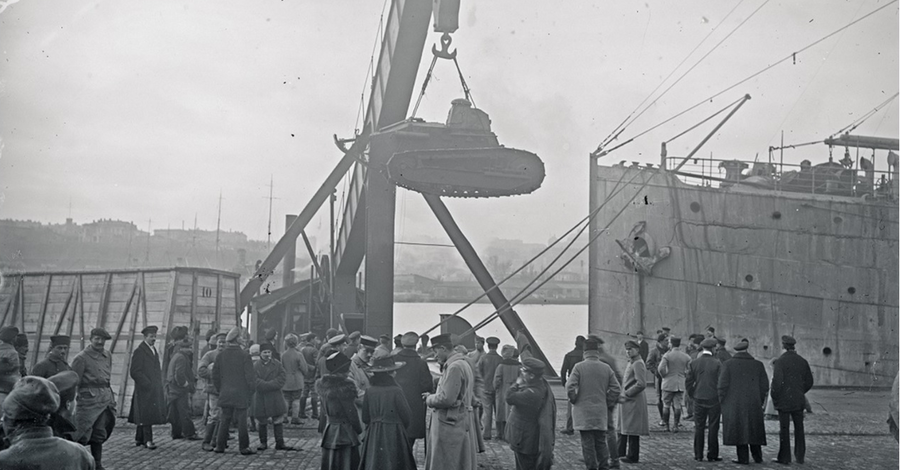
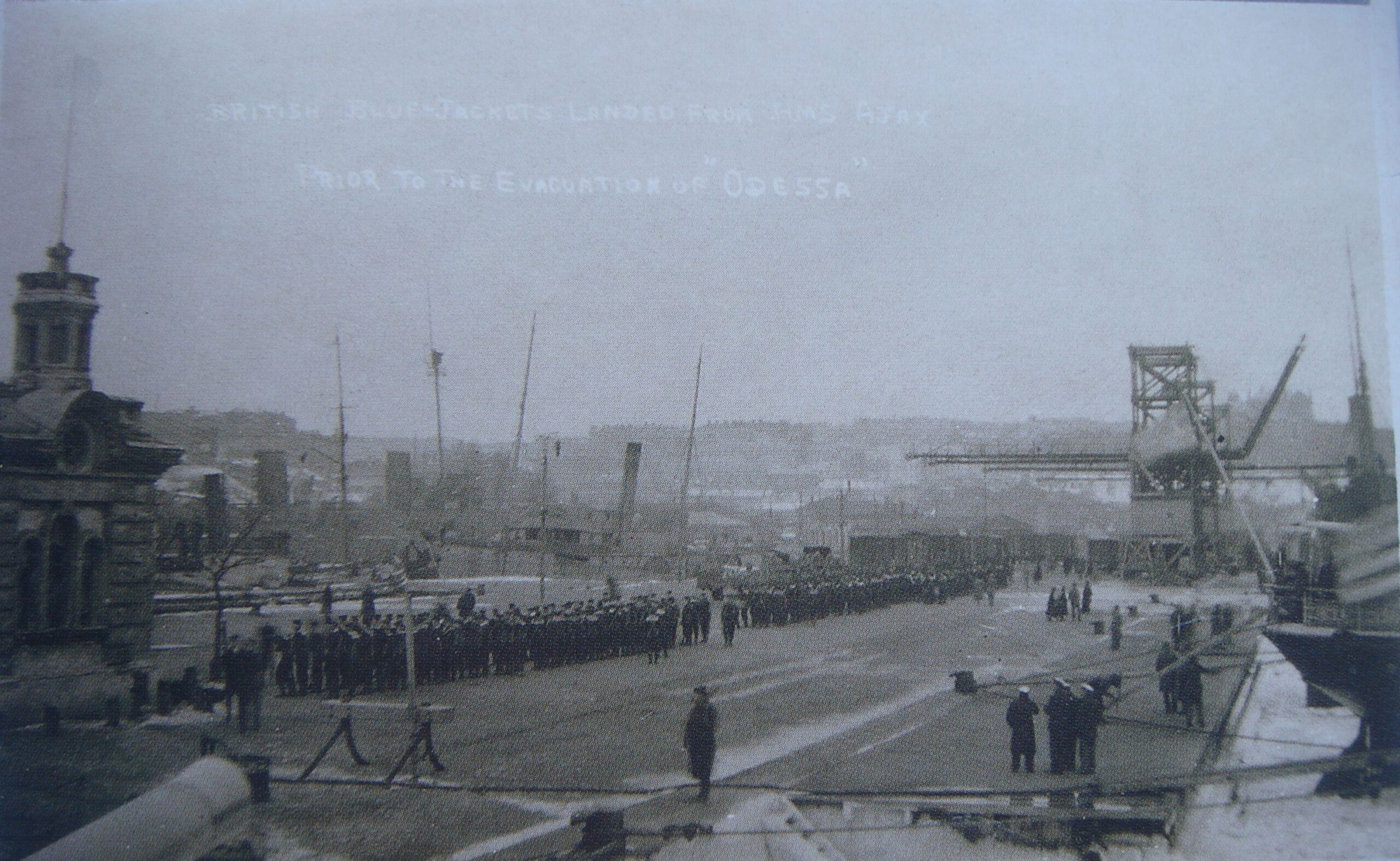
 The news of the evacuation of foreign troops sparked uprisings in the working-class outskirts of Odessa—Moldavanka, Peresyp, and Mlyny—where power shifted to the hands of militias composed of Bolsheviks, anarchists, and left-wing Social Revolutionaries. Criminal elements also took advantage of the situation, primarily the Jewish Youth Brigade of 300 people led by Mishka Yaponchik. The commander of the Odesa garrison, General V. Biskupsky, attempted to suppress the armed uprisings in the outskirts, but the troops withdrawn from the front were unable to deal with the bandits. Chaos reigned outside the city center. On April 6, 1919, the forces of Ataman and Red Army Commander N. Hryhoriev entered the city, declaring that he was the one who had taken Odessa and defeated the French.
Between April 3 and 7, approximately 25,000 Entente troops were evacuated from the Odessa port, while Tymanovsky’s brigade, which was denied boarding on French ships in Odessa, was forced to abandon all heavy weapons, armored vehicles, and artillery and fought their way out of Odessa towards Romania. At the Dniester Estuary, after crossing into Bessarabia, the brigade was taken aboard French ships. Polish legionnaires also retreated from Odesa along the same route. On April 14, Soviet troops took Rozdilna. The Romanians withdrew beyond the Dniester. Ovidiopol was captured on April 18, and soon after, Tiraspol was taken as well.
The second Soviet rule in the city lasted from April 8 to August 23, 1919, when Ataman Hryhoriev’s troops entered the city. The city then fell under the control of Denikin’s Volunteer Army from August 1919 to February 7, 1920. The capture of Odessa by the “Whites” led to the Bolsheviks losing most of the southwestern territories for a time.
Meanwhile, General Anton Denikin, the commander of the Volunteer Army, had grand plans to capture Moscow. Denikin’s troops managed to fight their way to Kyiv and Orel, but the army, exhausted from World War I and facing serious problems with supplies and ammunition, could no longer withstand the growing Bolshevik forces, Petliurists, Makhno’s forces, and other various band formations of that time. Later, the Bolsheviks launched their own offensive—towards the south. Relations with the Entente allies began to weaken, and Lenin, understanding their pragmatic interests, did not hesitate to take advantage of the situation. Thus, at the beginning of 1920, the remnants of the volunteer forces, along with British ships, hastily left Odessa, taking with them members of the intelligentsia and those who could not reconcile with Bolshevik rule.
From February 7, 1920, after the city was taken by Kotovsky’s cavalry brigade, Soviet power was firmly established in Odessa, marking the end of the war in this region.
READ MORE→
_______________________________
The text was translated from Ukrainian by Artificial Intelligence