
Previous section (click the link to return):
←4.1.Odessa (Odesa). Period 1794-1822♦
←4.2.Odessa (Odesa). Period 1823-1899↓
←3.1.Northern Black Sea Region XV-XVIII centuries♦
←3.2.Hocabey-Khodzhabey (Khadzhibey). Period of XV-XVIII centuries↓
←3.3.Khadzhibey-Odessa. Period XVIII century. Northern Black Sea Region XVIII century↓
←2.1.Kotsubey (Kochubiyiv). Period XV century. Eastern Europe II-XV centuries♦
←1.1.Ancient cities in the place of modern Odesa♦
Ukraine during the Revolution of 1905-1907. Political and social movements. “Prosvita”
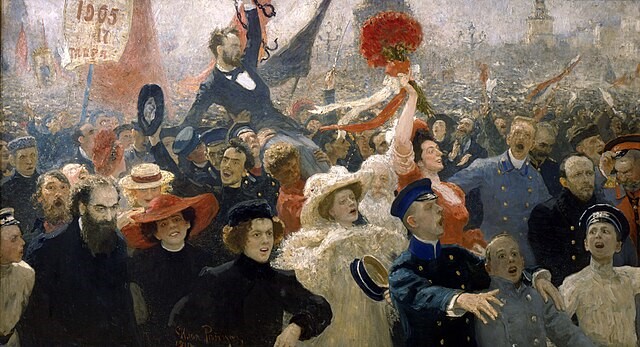 The events of the revolution were the result of a nationwide crisis that intensified at the beginning of the 20th century, due to the economic crisis of 1900-1903 in the Russian Empire and the defeat in the Russo-Japanese War of 1904-1905. The immediate catalyst for revolutionary protests was the events of Bloody Sunday (1905).
The events of “Bloody Sunday” sparked a wave of protest throughout the Russian Empire, including Ukraine. Mass strikes by workers and peasant uprisings began, shaking the empire throughout the spring and summer of 1905. Workers demanded an 8-hour workday, higher wages, improved living conditions, and the overthrow of autocracy, while peasants fought for the confiscation and redistribution of landlords’ land. This was the first truly popular revolution in the Russian Empire.
At the initiative of the intelligentsia, who sought to organize the spontaneous peasant movement, a mass political organization, the All-Russian Peasant Union, emerged in the summer of 1905. In Ukraine, seven provincial, 12 district, and 120 village committees of the Peasant Union were active, with Ukrainian activists—representatives of zemstvos, political parties, and cooperatives—actively participating. The peak of the peasant movement for land occurred in the summer and autumn of 1905, with events sometimes taking on a dramatic character. In the autumn, there was a peasant uprising in the village of Velyki Sorochyntsi, which was brutally suppressed by regular cavalry of Don Cossacks.
In Ukraine, from October to December 1905, there were over 1,800 peasant uprisings in 64 counties (out of 94). In total, in 1905, there were about 4,000 peasant uprisings in Ukraine, covering 6,884 villages with a population of over 5 million people. The uprisings occurred mainly in the Left Bank and Southern Ukraine.
The fact that the ground was burning under the feet of the imperial authorities was evidenced by disturbances in the army and navy. In the Black Sea, the crew of the battleship “Potemkin” revolted. Seizing the ship and electing their leadership, headed by Ukrainian sailors Panas Matyushenko and Hryhoriy Vakulenchuk, the crew, consisting mainly of Ukrainians, raised the red flag and directed the ship to Odesa. Among the officers who joined the uprising was O. Kovalenko, one of the organizers and leaders of the Revolutionary Ukrainian Party (RUP). “Not wanting to surrender to the tsarist authorities,” the crew of the “Potemkin” sailed to Constanța, where they sought political asylum in Romania.
In November 1905, a battalion of sappers led by Borys Zhadanivsky revolted in Kyiv. Ukrainian political parties were in the midst of the revolutionary struggle. The Ukrainian Social Democratic Labor Party (USDLP) achieved particular success, working among peasants, drawing many of them into its ranks, and directing them towards organized struggle. The USDLP also actively worked among students, workers, and intellectuals, strengthening during the years of the revolution. Together with the Bund, it formed self-defense units in Poltava to protect against pogroms carried out by the “Black Hundreds.” In Ukraine, the “Union of Autonomists” was also formed, a political organization in the Russian Empire in 1905-1906, advocating for the restructuring of Russia based on national autonomy and federalism. It was created at the initiative of I. Baudouin de Courtenay at a congress of representatives of the nations oppressed by the empire, including Ukrainians.
The culmination of the 1905 revolution was the general October political strike, which paralyzed the state. During the strike, which involved 2 million workers (120 thousand in Ukraine), strikers began to create their own governing bodies—Workers’ Councils, which coordinated revolutionary actions. Under pressure from workers and peasants, Nicholas II was forced to make concessions and issued the “Manifesto” on October 17, announcing political freedoms, an 8-hour workday, and promising to convene a parliament—the State Duma, elected by representatives of all social classes.
The last flare-up of the revolution was the December armed uprising of workers, which began in Moscow. In Ukraine, especially fierce armed clashes took place in mid-December 1905 in the Donbas, mainly in Horlivka. However, the Don Cossacks brutally suppressed the workers, quelling the uprising. The revolution gradually subsided, although the country was still shaken by peasant uprisings and worker strikes until the spring of 1907.
The Revolution of 1905 had a significant impact on the rise of the Ukrainian national liberation movement, which not only grew and became politicized on the overall revolutionary wave but also emerged from the underground, declaring itself openly to broad segments of the population. On the eve of the revolution, the struggle for the legalization of the Ukrainian language intensified in Ukraine: zemstvos and city councils adopted resolutions on this matter, and petitions to the government were written by congresses of scholars and theatrical figures. The Russian Academy of Sciences formed a commission led by the Slavist Oleksiy Shakhmatov, which recommended the government lift restrictions on the Ukrainian language. The Church Synod, to strengthen the propaganda of Orthodoxy, allowed the translation and publication of the Bible in Ukrainian.
Finally, in the autumn of 1905, the government lifted the ban on the Ukrainian language. Although importing Ukrainian books from abroad was still prohibited, a broad publishing movement developed in the Russian-ruled Ukraine, with the number of publishing houses reaching seventeen. Among them, the most active were “Vik,” “Chas,” “Krynytsia,” “Ranok,” and others. During 1905-1907, 21 Ukrainian newspapers were published in Dnieper Ukraine and another four in Russian provinces. The first such publication was the “Khliborob” newspaper, published at the end of 1905 in Lubny. Later, “Ridny Krai” (Poltava), “Visti” (Odesa), “Zaporizhzhia” (Katerynoslav), “Slobozhanshchyna” (Kharkiv), and others appeared. The largest number of Ukrainian newspapers was published in Kyiv, where centers of all national parties operated. In particular, the Ukrainian Radical Democratic Party (URDP), funded by Vasyl Symyrenko and Yevhen Chykalenko, published the most influential magazine in Ukraine, “Hromadska Dumka.”.
As soon as the chains of oppression fell, the Ukrainian movement began to penetrate all spheres of life and activity—into villages, schools, culture, and the economy. A vivid testimony to this was the spread of cooperative organizations. In 1907, 50 Ukrainian cooperatives operated in Kharkiv region, 193 in Kyiv region, and 200 in Podillia. In every city, there were now legally existing communities, Ukrainian clubs, and reading rooms. Encouraged by the general uplift, professors Mykola Sumtsov in Kharkiv and Oleksandr Hrushevsky in Odesa began teaching Ukrainian studies in their native language. At the end of 1905 and the beginning of 1906, “Prosvitas” (Enlightenment Societies) began to emerge in large and small cities of Ukraine, modeled after the Galician “Prosvitas” (the Prosvita Society, founded in 1868 in Lviv as a counterbalance to anti-Ukrainian trends in cultural life). However, unlike the latter, the Dnieper Ukrainian organizations did not have a single center, and each operated independently. Moreover, they were extremely politicized, gathering and working with all anti-imperial forces. The largest Prosvitas in Great Ukraine were in Kyiv, Chernihiv, Poltava, Odesa, and Kamianets-Podilskyi. They also appeared in Volhynia, Kholmshchyna, Kuban, Kazakhstan, Baku, and Vladivostok. Leading national democratic figures of the time actively participated in the work of Prosvitas—Panasi Myrnyi (Poltava), Lesia Ukrainka, Mykola Lysenko (Kyiv), and Mykhailo Kotsiubynskyi (Chernihiv).
The first Prosvita in Dnieper Ukraine was established at the end of 1905 in Katerynoslav, a city with certain national traditions. It was here that Oleksandr Konysky and his like-minded people decided to establish the Shevchenko Society in Lviv, created a museum of Zaporizhzhia Cossacks, and where the prominent historian of the Sich, Dmytro Iavornytsky, settled permanently. Together with Volodymyr Antonovych’s student, A. Syniavsky, local historian Vasyl Bidnov, and other figures of Ukrainian culture, they founded the Prosvita and began publishing its organ, the newspaper “Dobra Porada,” which, however, was soon closed by the authorities. Over time, the Katerynoslav Prosvita established about a dozen branches in the villages of the province. Under the colonial policy of the Russian monarchy, the activities of the Prosvitas became a significant liberation protest, a manifestation of the people’s desire for national and cultural freedom. Most of the Prosvitas were consciously under the influence of Ukrainophilism, and thus played a major progressive role in the development of culture. Prosvita members printed Ukrainian books, organized concerts, evenings, theatrical troupes, and performances, opened libraries, Sunday schools, and spread the cooperative movement.
At the beginning of 1906, the first elections to the parliament, the State Duma of the first convocation, took place in the Russian Empire. They were held in the context of the decline of the revolution, sharp political struggle, and government proscriptions. Ukrainian socialist and radical national parties did not participate in the elections, trying to continue the revolution until the complete overthrow of imperialism. Only the Radical Democratic Party took part in the elections, winning several Duma seats. In total, 95 delegates were elected from Ukraine, mainly from Russian parties, including 63 Ukrainians, 22 Russians, 5 Poles, 4 Jews, and 1 German. Among them were nobles, priests, peasants, and commoners. Forty-four Ukrainian deputies, to defend common demands, united in a Ukrainian parliamentary community, which they wanted to gradually transform into a party. The local Ukrainian community in St. Petersburg also joined the parliamentary community. Mykhailo Hrushevskyi arrived from Lviv to the Russian capital and led the community’s activities. He sought to unite representatives of various groups and parties in a single movement, to free them from the captivity of inter-factional struggle, and to lead them on the path of progress towards a common goal. To inform the masses about the activities of the Ukrainian Duma community, M. Hrushevskyi took on editing and publishing the magazine “Ukrainsky Vestnik”.
The Ukrainian parliamentary community prepared a manifesto demanding the autonomy of Ukraine, intending to read it in the Duma and fight for its implementation. However, in the midst of the unfolding work, the emperor dissolved the parliament and announced elections to the II Duma. In protest against the actions of Nicholas II’s government, the deputies went to Vyborg and adopted a resolution there against the imperial government. Ukrainian deputies also signed the document. For this, they were tried and deprived of the right to participate in the elections to the II Duma. The elections to the II Duma were also held under great tension. Deputies from Ukraine in it also formed a parliamentary community of 47 people, which began publishing the newspaper “Ridna Sprava.” In it, parliamentarians explained that the struggle for a better fate for Ukraine is the “native cause” of everyone who lives there.
The parliamentary community of the II Duma created a commission that prepared a number of draft laws on the introduction of the Ukrainian language in schools, universities, administrative institutions, the opening of Ukrainian departments, autonomy, and local self-government. Frightened by the radicalism of the deputies of the II Duma, the emperor, after 103 days, dissolved it, drastically changing the electoral law in favor of the landlords. The emperor’s manifesto of 03.06.1907 on the dissolution of the II Duma marked the refusal of imperialism from reforms and the final defeat of the revolution of 1905-1907. In the III and IV Dumas, it was no longer possible to create a Ukrainian community and fight for any rights for Ukraine and Ukrainians, although there were still Ukrainian deputies in them.
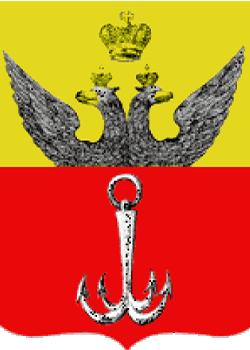
Odessa. Period 1900 – 1914
1791 – 1917 – Russian Empire
1803 – 1917 – Kherson Governorate
1827 – 1917 – Odesa District
1856 – 1917 – Own City Administration
In 1900, the population of Odesa was about 450,000 people, making it the fourth-largest city in the country after Warsaw, Moscow, and Saint Petersburg.
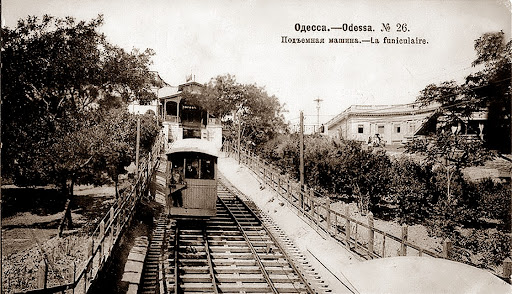
On June 8, 1902, the first funicular in Ukraine (the second in the Russian Empire) was opened. In 1903, with funds from Count M. M. Tolstoy, an emergency station was opened. Pilots Mykhailo Yefimov (on March 21, 1910), and a week later Serhiy Utochkin at the Odesa racetrack, made the first flights in the Russian Empire on an airplane.
“…in Odesa in 1899, there were eight Belgian joint-stock companies, one French, and one British. The total capital amounted to 12,181,000 rubles, almost as much as the Russian shareholders invested — 15,282,928 rubles. In addition to the joint-stock companies, there were over five hundred industrial enterprises entirely owned by foreigners” — Patricia Herlihy.
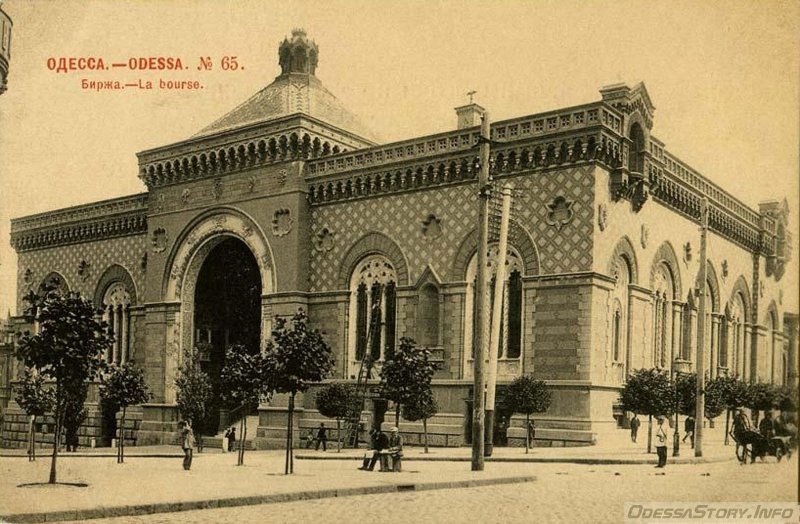
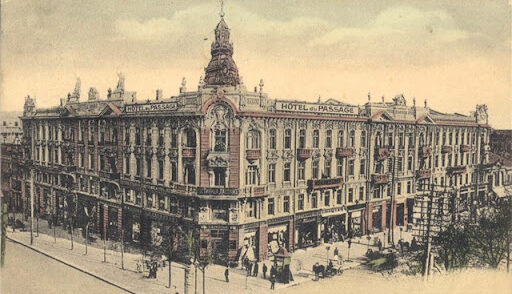
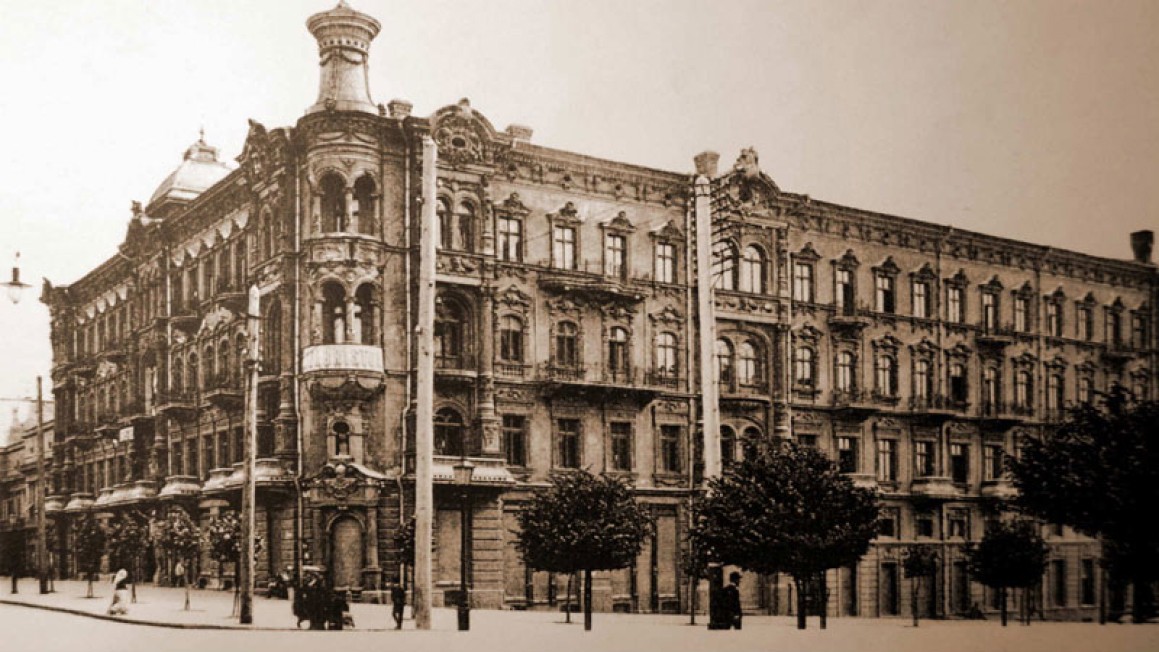
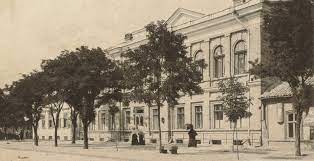
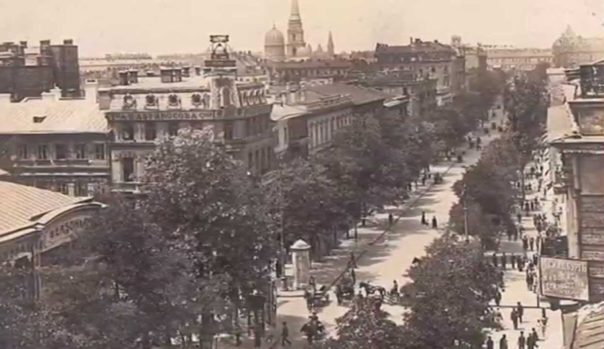
 During this period, several buildings that became architectural landmarks were constructed, including the Bristol Hotel (1898–1899, architects Aleksandr Bernardazzi and Adolf Minkus), the Passage Hotel (1898–1899, architect L. L. Vlodek), the New Exchange (1894–1899, project author and international competition winner V. I. Prokhaska, architect A. I. Bernardazzi), one of the best examples of library architecture in the country—the new building of the City Public Library (1904–1906, architect F. P. Nesturkh), and the Falz-Fein House (1899, architects L. L. Vlodek, S. A. Landesman). In 1897, one of the city’s most important religious structures, the center of Lutheranism in Odesa—St. Paul’s Church (now the Central Lutheran Cathedral of Ukraine St. Paul), was built. The first Lutheran church on this site appeared sixty-nine years earlier, but due to dilapidation, it was almost entirely dismantled and a new temple was erected on the foundations, designed by architect Herman Scheurembrandt. This new temple surpassed its predecessor in both beauty and size. At the same time, a construction boom began in the Russian Empire: new income houses, hotels, and other structures began to appear in the central part of Odesa. Most construction took place in the Center and Moldavanka, but poor areas of the city such as Peresyp, Slobidka-Romanivka, Slobidka-Baltyka, Blyzhni and Dalni Mlyny, and others remained largely unchanged.
In 1905, one of the greatest tragedies in the city’s history occurred with the onset of the Russian Revolution of 1905–1907. In the summer of 1905, one of the most famous events of that revolution took place. The sailors of the battleship “Prince Potemkin-Tavricheskiy” staged a mutiny, the first military revolt during the revolution. After the sailors took control of the battleship at sea, the “Potemkin” arrived in Odesa. Upon the battleship’s arrival in the port, the sailors and the city crowd began looting and burning port warehouses. These events resulted in significant civilian casualties and losses for merchants. Between 500 and 1,000 people died, and the damages amounted to about 10 million Russian rubles. During the same revolution in Odesa, as in many other cities of the Russian Empire, a wave of anti-Jewish pogroms occurred. According to contemporary Israeli historians, around 400 Jews were killed in Odesa alone in 1905. During the revolution, Odesa ceased to be a peaceful city. Many foreign revolutionary organizations found refuge there, and combined with local workers and students, they were drawn into the country’s socialist revolutionary movement.
In 1906, the “Prosvita” society began operating in the city, which had its own library and historical museum. With the society’s support, Professor Oleksandr Hrushevskyi gave lectures on Ukrainian studies at the local university. The “Leonid Smolensky Fund” was established to publish books. After the establishment of the Stolypin regime, repression began, intensifying after the June 3 (16), 1907, coup d’état. By the resolution of the Odesa Governor-General dated March 31, 1908, the Odesa “Prosvita” was prohibited from holding “lectures, readings, and singing in the Little Russian dialect.” On November 28, 1909, the Odesa “Prosvita” ceased to exist. According to Vasyl Veryha, the authorities closed the society as undesirable after the appearance of Ivan Bondarenko’s book “About Garibaldi”.
After the revolution ended, the city gradually began to recover, and economic growth resumed. The 1910 Factory, Industrial, and Agricultural Exhibition provided a certain stimulus. At the same time, the Belgian anonymous society, which had been a monopoly in Odesa since the days of the horse-drawn tram, established an electric tramway service. Thanks to this, the city acquired 80 kilometers of tram tracks that traversed the entire city center.
Three years later, in 1913, the school of the Odesa branch of the Imperial Russian Musical Society was transformed into a new educational institution—the Odesa Conservatory (now the Odesa National Music Academy named after A. V. Nezhdanova).
READ MORE→
_______________________________
The text was translated from Ukrainian by Artificial Intelligence